
A tire just let go at speed. Do these five things.
Do not brake hard and do not fight the wheel with sudden corrections. Hold your lane, keep light power on until the truck is stable, then ease off and work to the shoulder. Which tire blew decides everything after that: a steer blowout is an emergency you just survived, a drive or trailer blowout is usually a roadside tire call rather than a tow.
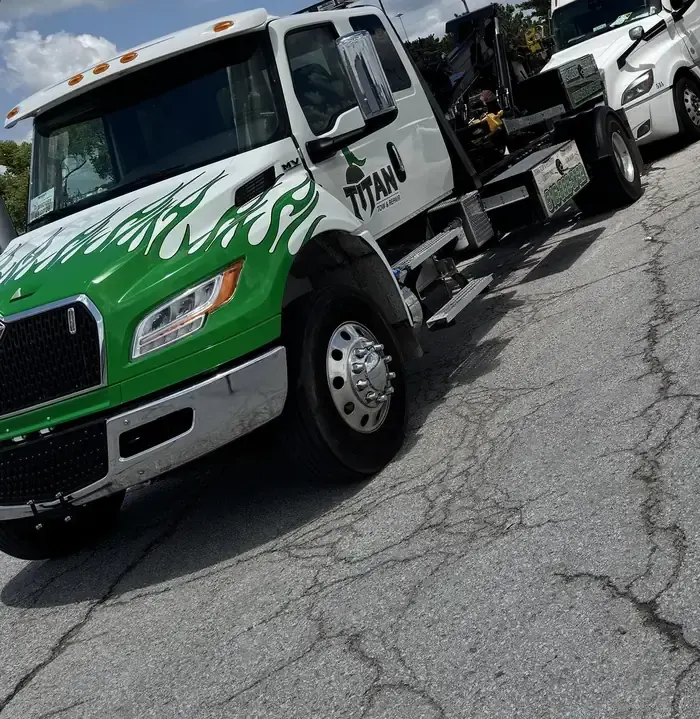
The first ten seconds
The instinct is to brake. The instinct is wrong. Hard braking on a blown tire shifts weight onto the failed corner and is how a blowout becomes a rollover or a jackknife. Grip the wheel with both hands, hold your lane, and keep a little throttle on — power keeps the rig stretched and stable while you steer through the pull.
The pull is the part drivers overcorrect. A tire letting go drags one corner rather than steering the truck, and the wheel wants a large, sudden input to answer it. Give it a small, held one instead.
Once the truck settles, come off the power gradually and work toward the shoulder. Signal early, move once, and aim for real width — a blowout survived on the road can still go badly on a shoulder too narrow to work on. If a wide spot or a ramp is close and the truck is stable, that is worth the extra quarter mile, on anything but a steer failure.
The next five minutes, in order
Once you are stopped, each step protects the one after it. Do these in order.
- Hazard flashers, before anything else. 49 CFR 392.22 requires the four-way flashers the moment a commercial vehicle stops on the traveled part of the road or on the shoulder, and they stay on until the warning devices are out.
- Warning triangles, within 10 minutes. The same rule gives you 10 minutes to place three. On a divided highway all three go behind the truck — within 10 feet, at 100 feet and at 200 feet — and every interstate around Kansas City is divided. Our post on where the triangles go covers hills, curves and the walk back.
- Get out on the safe side. Climb down away from traffic, wear a vest, and never stand in the gap between your trailer and the white line.
- Walk the damage from a safe angle. Which axle, which side, inside or outside dual, and what the tread took with it. Look; do not crawl under anything, and keep your hands off a wheel end that has been working.
- Call with the details, not the headline. Highway and mile marker, direction of travel, tire position, sidewall size if you can read it safely, and what else is broken.
Steer, drive or trailer — three different events
A blowout is not one fault with one answer. The axle decides how dangerous the moment was, whether the truck can move, and what comes out on the service truck.
- Steer tire. The serious one. The truck pulls hard toward the failed side and the front axle is down to one contact patch with nothing sharing the load. Once stopped, that axle does not roll again until the tire is replaced — a stop-where-you-are call, never a limp-to-the-next-exit call.
- Drive tire. Duals buy you grace: the surviving tire carries the corner briefly. Grace, not permission — the survivor now carries the pair's load and builds the heat that takes it out next, while the flailing carcass of its dead partner destroys mudflaps, air lines and wiring.
- Trailer tire. The most common and the most tempting to ignore. The rig barely pulls, and drivers roll on for miles while the shredding carcass beats the trailer's underside apart and throws rubber at every car behind them.
- Wide-base singles. A truck on wide-base singles has no second tire on that corner at any position, so a failure there behaves like a steer failure wherever it happens.
What a blowout takes with it
A casing coming apart at highway speed is a flail weighing dozens of pounds, inches from things never built to be hit. The tire is rarely the whole repair, which is why "I have a flat" describes very little of what is sitting on the shoulder.
- Air lines. The supply and service lines running along a trailer frame are the classic casualty. A cut line dumps the system, the spring brakes set, and the trailer will not move until it is repaired — our guide to air leaks at the roadside covers what happens next.
- Brake lines and chamber hoses. Closer in and more serious. Damage to a line at the wheel end is not a limp-to-the-shop fault, because 49 CFR 393.48 requires all brakes with which a vehicle is equipped to be capable of operating at all times.
- Wiring and lights. The lighting harness runs the length of the trailer frame through the space the carcass was just occupying. Dead lamps down one side hold a load at a scale even though the truck drives perfectly.
- The mudflap and its hanger. Flaps go first and the bracket often goes with them, bent back into the tire or torn off. A missing flap throws water and stones at everything behind you, and a bent hanger can end up against the new tire.
- The trailer underside. Floor boards, cross members, wiring clips, side skirts and reefer fuel lines all live where the tread was flailing. A loose piece left dragging on a rotating tire is a fire risk.
What the rules say about rolling on
Drivers ask whether they can finish the run, and the answer sits in the federal equipment rules rather than in anyone's opinion. 49 CFR 393.75 says no motor vehicle shall be operated on a tire that is flat or has an audible leak, that has body ply or belt material exposed through the tread or sidewall, or that has any tread or sidewall separation. A blown tire is usually all three at once. It is already outside the rule.
The same section sets the tread depths — at least 4/32 of an inch in a major tread groove on the steering axle of a truck or truck tractor, and at least 2/32 on all other wheels — and requires a cold inflation pressure not less than that specified for the load being carried. Those numbers decide whether the surviving tires on that axle are still legal once the failed one is gone.
There is one narrow allowance. 49 CFR 396.7 forbids operating a vehicle in a condition likely to cause an accident or a breakdown, and permits continuing only to the nearest place where repairs can safely be effected, and only where that is less hazardous than leaving it where it is. That is a reason to creep off a bridge deck, not a reason to make the next truck stop. Our post on DOT out-of-service faults covers what an inspector looks at.
What the service truck brings
Mobile tire service means the tire comes to the truck. The service truck carries commercial tires in the common sizes, which is why we ask for the position and the size on the phone — the difference between one road call and two trips is usually that detail. Read the sidewall if you can do it safely from the side away from traffic.
On arrival the wheel comes off, the position is inspected, the new tire goes on, and the fasteners are torqued to spec rather than run up on a gun and trusted. Stud and lug damage is part of the same job, and so is the collateral repair: an air line spliced, a lamp or a section of harness replaced, a mudflap and hanger put back on. Those are ordinary mobile truck repair and trailer repair jobs, on the same visit. What sets the length of the call is in our post on how long a roadside truck tire replacement takes.
The boundary matters as much as the capability. We are not a tire shop: no retreading, no walk-in counter, no wheel alignment. A repairable puncture in the tread area of a sound casing gets repaired; a sidewall injury, a heat-damaged casing or anything run flat gets replaced, and a steer position gets the most conservative call of the three. If a failure has damaged a wheel seal or cooked a bearing, that wheel end comes apart on a bench somewhere else.
Roadside tire service or a tow?
Most blowouts are roadside calls that end with the truck driving away. The tire is replaced where it sits, the damage the carcass did is repaired far enough to be legal and safe, and the load keeps moving. That is the outcome to expect on a drive or trailer failure caught quickly.
It becomes a tow when the blowout was the start of something bigger: a steer failure that put the truck somewhere it cannot be worked on safely, wheel-end or hub damage beyond a tire and its hardware, brake line damage that makes the combination unsafe to roll under 393.48, or a trailer beaten up badly enough underneath that a lamp and a splice will not make it legal again. Then the unit is moved rather than patched, and a trailer can go on its own without the tractor waiting beside it.
Either way it is one phone call: the service trucks and the wreckers run out of the same yard in Liberty.
Sources
- 49 CFR 392.22, Emergency signals; stopped commercial motor vehicles
- 49 CFR 393.48, Brakes to be operative
- 49 CFR 393.75, Tires
- 49 CFR 396.7, Unsafe operations forbidden
Related reading
Gelled Fuel and Frozen Air Lines: Winter Truck Breakdowns — When a truck dies in a Missouri cold snap it is usually one of two things: diesel gelled in the filters, or moisture frozen in the air system.
DOT Out of Service: Faults That Freeze a Running Truck — An out-of-service order means the vehicle legally cannot move until the listed fault is repaired, even if it runs perfectly.
Hot Shot Truck Broke Down: Who Actually Tows It? — A hot shot — a one-ton or medium-duty pickup pulling a gooseneck or flatbed — sits in a gap.
What this covers
Mobile tire service
A blown tire is the most common thing that stops a truck, and the one most often fixed on the shoulder. We bring the tire to you rather than the truck to a shop.
Mobile tire service detailsMobile truck repair
Our service truck carries the parts and the tools. Faster for your driver, cheaper for your office, and the load keeps moving.
Mobile truck repair detailsMobile trailer repair
Most trailer faults do not stop a trailer moving. They stop it being legal to move, which is worse — the load sits while the paperwork says it cannot go anywhere.
Mobile trailer repair detailsIn a specific city: Diesel mechanic and mobile semi truck repair in Kansas City, Missouri · Mobile truck and trailer repair in Riverside, Missouri · Mobile truck and trailer repair in Liberty, Missouri · Mobile semi truck and trailer repair in Saint Joseph, Missouri · Mobile truck repair and a diesel mechanic on call in Topeka, Kansas