Your hot shot is down with a loaded gooseneck behind it. Who actually comes?
A hot shot — a one-ton or medium-duty pickup pulling a gooseneck or flatbed — sits in a gap. A light-duty rollback cannot take the combination, and many heavy-duty outfits will not send a wrecker for it. We do: the truck and the loaded trailer both get moved, and often the truck gets fixed where it stands instead.
What a hot shot actually is
In practice, two things go by the name. The common one is a one-ton dually pickup — a 3500 or 350 class truck — pulling a gooseneck, a flatbed or a step deck, often thirty to forty feet of trailer with freight strapped to it. The other is a medium-duty cab-and-chassis, a Class 4 to 6 truck with a deck or a hitch on the back, running the same kind of expedited work. Both exist to move one load, fast, without waiting for a full trailer to fill.
That is the operating difference from a Class 8 rig, and it has an equipment consequence. The truck at the front is close to something a light-duty operator sees every day. The trailer behind it, loaded, is not. Nothing in the combination is exotic. It just does not match the equipment either side of it carries.
Regulation treats hot shots as commercial vehicles all the same. Under 49 CFR 390.5T, a vehicle used on a highway in interstate commerce with a gross vehicle weight rating or gross combination weight rating of 10,001 pounds or more is a commercial motor vehicle. Under the CDL group definitions in 49 CFR 383.91, a combination rated at 26,001 pounds or more with a towed unit rated over 10,000 pounds is a Group A vehicle. Plenty of hot shots sit right on those lines.
The class nobody claims
Empty, the pickup on its own is a light-duty tow. Loaded and hitched, the combination is nothing of the kind. A rollback that would happily carry the pickup cannot do anything about the trailer, and a light-duty operator who turns up to a hot shot call usually leaves again.
The heavy-duty side has the equipment but often not the interest. A loaded hot shot is a small job for a heavy wrecker, and plenty of operators would rather hold the truck for a Class 8 call. So the driver ends up phoning down a list, describing the same combination to people who each say it is not quite what they do. That gap is the reason this page exists, and the short answer to the question in the title is: we do. Flatbed or wrecker covers how that choice is normally made, and a hot shot is the case where the answer is often both.
What moves the truck, and what moves the trailer
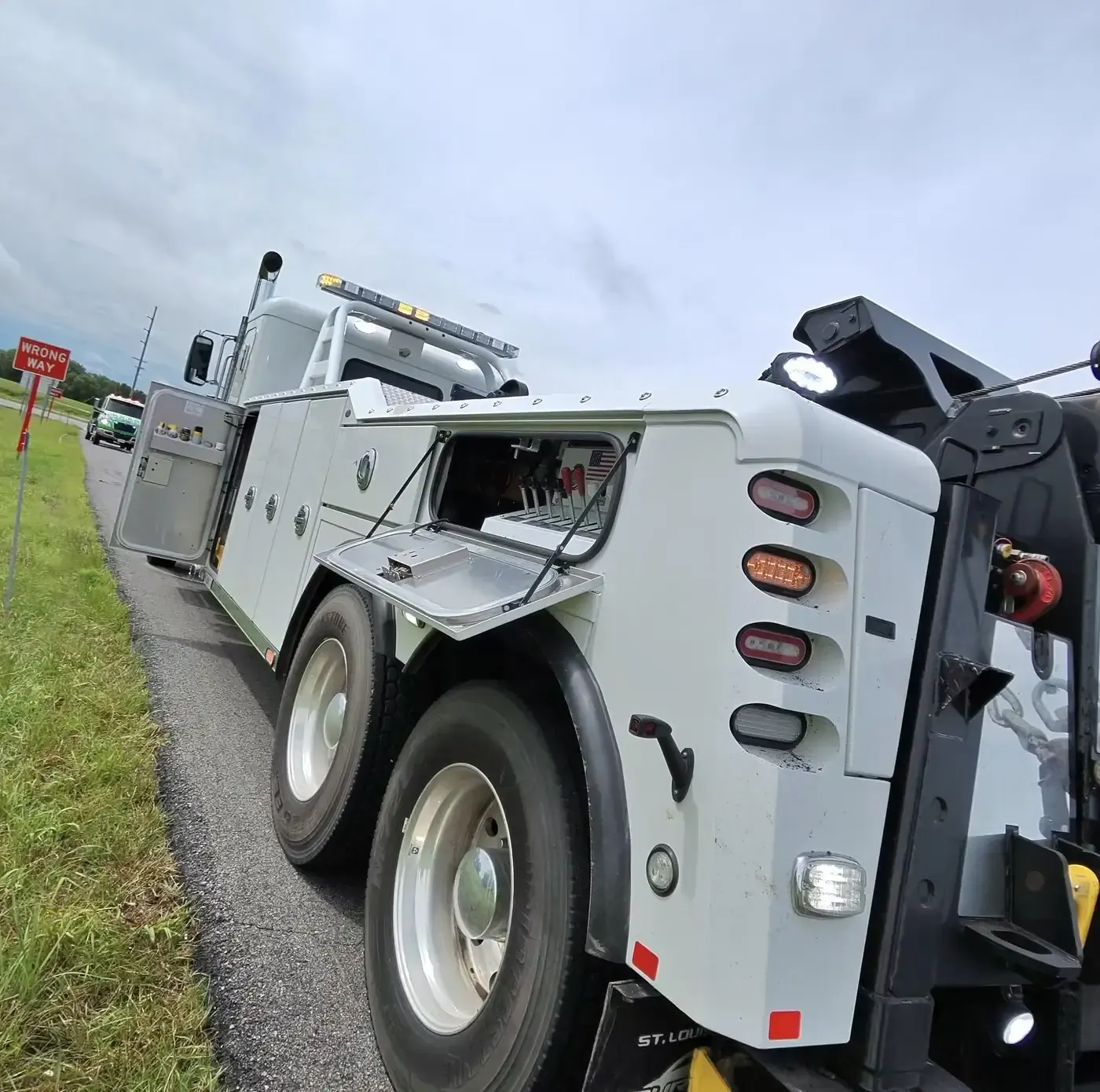
These are two jobs that happen to be in the same place, and it helps to think of them that way from the first phone call. The pickup or cab-and-chassis goes on a rollback deck or behind a wrecker, whichever suits its weight, its damage and where it is parked. A dually on a deck needs the width checked; a medium-duty cab-and-chassis usually goes behind a wrecker.
The trailer is the part that rules out light-duty equipment, and the hitch is why. A gooseneck coupler sits over the bed of a pickup and drops onto a ball mounted through the bed floor; a fifth wheel is a plate. Neither is something a light rollback is set up to take. Moving a loaded gooseneck means hitching it to equipment that has the right coupling and the rating to pull it, which on our side of the yard means the heavy-duty equipment rather than the rollback.
A roadworthy loaded trailer is moved as-is, hitched and taken wherever you need it: your yard, a repair shop or the delivery. We do not unload it and we do not re-secure your freight beyond what is needed to move it safely. If the trailer itself is what failed — lights, brakes, tires, wheel ends, running gear — that is trailer repair work done where it stands, and a trailer that can be made legal on the shoulder never needs a tow at all.
What happens to the load
The default is that the load stays exactly where it is. 49 CFR 393.100 requires cargo to be contained, immobilized or secured so it cannot shift enough to affect the vehicle's stability, or leak, spill or fall, and a load that already meets that standard is best left alone. Every time freight is touched, someone becomes responsible for how it is secured next.
Three things change that. A load that has already shifted has to be stabilized or re-secured before the trailer moves, because the trailer's center of gravity is no longer where it was planned to be. A trailer damaged badly enough that it cannot roll may mean the freight is transferred to something that can. And a load whose height or width makes the trailer awkward to route has to be planned around before anyone sets off — a forty-foot trailer with machinery on it fits under things a pickup never thought about.
What we will not do is decide on your behalf. Tell us what the freight is, whether it is time-critical, and where it has to end up. Where a load is hazardous, sealed, high-value or subject to a customer's own handling rules, say so first, because that changes the answer before the equipment question does.
Why the real weights matter more than you think
The single most useful thing a hot shot driver can do on the phone is give real numbers instead of round ones. Dispatch is deciding which truck leaves the yard, and that decision runs on weight.
- An understated weight sends the wrong truck. A second dispatch costs you the wait again, and on a shoulder that is the expensive part, not the mileage.
- Capacity is not a suggestion. Every deck, wheel lift, underlift and hitch has a rating. A truck sent to a job over its rating either cannot do it or should not, and nobody benefits from finding that out on scene.
- Trailer weight and truck weight are separate numbers. Each half matters on its own, because the two often travel on different equipment.
- The load is part of the weight. "A gooseneck" and "a gooseneck with a skid steer on it" are different jobs. Say what is on it.
- Read the plates. The GVWR on the truck's door jamb and the trailer's data plate settle it, and they are easier to read than to estimate.
- Say when you do not know. An honest "I am not sure, it is a two-car hauler with one car on it" beats a confident wrong figure.
What we need to know when you call
- The truck. Make, whether it is a dually, and whether it is a pickup or a cab-and-chassis. That decides which of our trucks comes for it.
- The trailer. Gooseneck, fifth-wheel or bumper pull, and roughly how long. The hitch type is the detail that rules out most light-duty equipment.
- The load. Loaded or empty, roughly what it is, how heavy and how tall it sits. Height matters for the route the trailer takes afterward.
- What failed. Engine, fuel, electrical, a tire, a wheel. Most hot shot faults are the same as any other diesel pickup's, and many are fixable where the truck is.
- Whether it still rolls and steers. A truck that rolls can be repositioned. One that will not has to be winched or skated on.
- Where you are and whether it is safe. Highway and mile marker or a cross street, and whether you are on a shoulder or in a live lane. That sets the priority before anything else does.
- Where it all has to end up. The truck and the trailer can go to two different places, and saying so up front is cheaper than arranging it twice.
Fixing it where it stands, which is usually the better outcome
The first thing worth checking is whether the truck needs moving at all. Hot shots fail the way diesel pickups fail: batteries, starters, alternators, fuel problems, DEF and sensor faults, blown tires, a belt. All of those are on the mobile repair list, and the service truck carries the parts and tools for them. If the truck is fixed where it is, you drive away with the trailer still hitched and the load never touched, which is the cheapest version of this day by a wide margin.
The honest boundary is the same one that applies to any roadside call. Engine internals, transmissions and anything needing a lift are shop work, and so is structural welding or an alignment. We do not run a rotator and we do not haul equipment on a lowboy. When the fault is one of those, the answer is a tow, and you should hear that on the phone rather than after two hours on a shoulder.
On the highway, get the combination onto the shoulder or off at an exit if it will still roll, get hazard flashers on and warning devices out to the distances in 49 CFR 392.22, and stay out of the live lane while you call. Where to place warning triangles sets out the placement, which differs between an undivided road and a divided highway.
Sources
- 49 CFR 390.5, Definitions
- 49 CFR 383.91, Commercial motor vehicle groups
- 49 CFR 393.100, Applicability and general requirements of cargo securement standards
- 49 CFR 392.22, Emergency signals; stopped commercial motor vehicles
Related reading
Can You Drive a Semi With a Blown Airbag? Loaded vs Empty — A loaded semi should not be driven on a blown air bag, and no truck should move with the axle down on the frame or a tire touching anything.
How a Semi Actually Gets Towed, Start to Finish — Towing a semi starts with a walk-around, not a hook.
What Happens to Your Load When the Truck Breaks Down — When a truck breaks down, the load takes one of three paths: the whole combination is towed together, a rescue tractor takes the trailer on while the dead unit gets repaired, or the trailer stands somewhere secure until a decision is made.
What this covers
Heavy-duty towing
A loaded tractor-trailer is not a bigger car. It needs a rated wrecker, a rated operator and a plan before anything gets hooked. That is what we send.
Heavy-duty towing detailsMobile truck repair
Our service truck carries the parts and the tools. Faster for your driver, cheaper for your office, and the load keeps moving.
Mobile truck repair detailsMobile trailer repair
Most trailer faults do not stop a trailer moving. They stop it being legal to move, which is worse — the load sits while the paperwork says it cannot go anywhere.
Mobile trailer repair detailsIn a specific city: Heavy-duty, semi and semi trailer towing in Kansas City, Missouri · Diesel mechanic and mobile semi truck repair in Kansas City, Missouri · Heavy-duty towing in Liberty, Missouri · Mobile truck and trailer repair in Riverside, Missouri · Mobile truck and trailer repair in Liberty, Missouri · Heavy-duty, semi and semi trailer towing in Kansas City, Kansas · Heavy wrecker service and semi towing in Saint Joseph, Missouri · 24/7 semi and heavy-duty towing in Oak Grove, Missouri · Heavy-duty and semi towing in Topeka, Kansas · Mobile semi truck and trailer repair in Saint Joseph, Missouri · Mobile truck repair and a diesel mechanic on call in Topeka, Kansas