
DOT out of service: the truck runs fine, but the inspector says it does not move.
An out-of-service order means the vehicle legally cannot move until the listed fault is repaired, even if it runs perfectly. Inspectors issue them for brakes, tires, lights, steering, suspension and load securement. Most of those are roadside-repairable, and fixing the fault where the truck sits is usually faster than towing it to a shop.
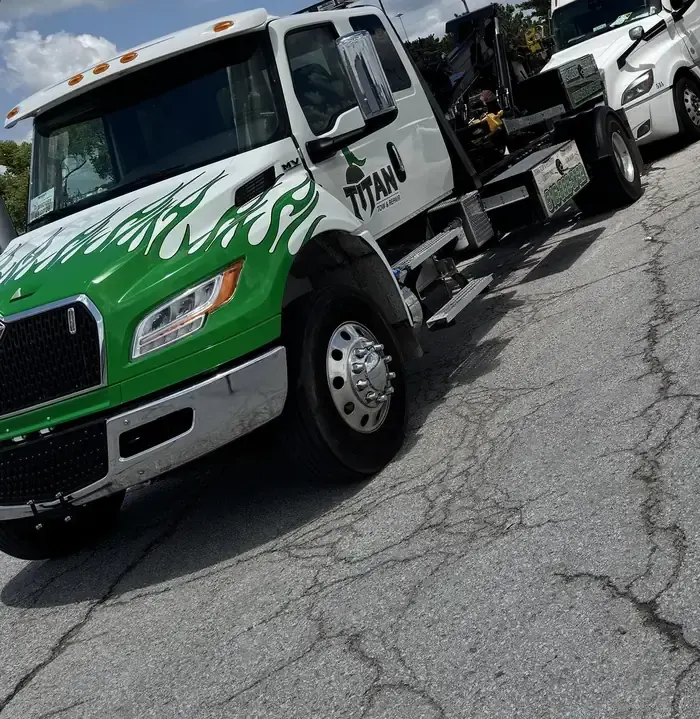
A truck can be roadworthy and still forbidden to move
An out-of-service order is not a mechanical verdict. It is a legal one. An inspector at a weigh station, a scale or a roadside inspection site finds a fault that meets the out-of-service criteria, writes it on the inspection report, and from that moment the truck does not move under its own power until that fault is repaired. The engine can be perfect. The order does not care.
The federal rule behind it is short and blunt. Under 49 CFR 396.9, authorized personnel declare and mark out-of-service any motor vehicle or intermodal equipment which by reason of its mechanical condition or loading would likely cause an accident or a breakdown. No carrier may require or permit anyone to operate a vehicle marked out-of-service until all repairs required by the notice have been satisfactorily completed, and nobody may remove the out-of-service sticker before those repairs are done.
That is why so many out-of-service trucks were driving fine ten minutes earlier. The driver felt nothing wrong because nothing a driver can feel was wrong.
Who declares it, and what the inspection actually covers
The decision belongs to certified commercial vehicle enforcement personnel, who work from the North American Standard Out-of-Service Criteria published by the Commercial Vehicle Safety Alliance. CVSA updates that criteria annually, effective April 1 each year, and inspectors use it to judge whether a driver or a vehicle presents an imminent hazard. The criteria are deliberately conservative: they describe the point at which a defect is too dangerous to drive one more mile.
The full North American Standard Level I inspection is a 37-step procedure covering both the driver and the vehicle. On the vehicle side that means brake systems, cargo securement, coupling devices, driveline components, the driver's seat, fuel and exhaust systems, frames, lighting devices, steering mechanisms, suspensions, tires, wheels, rims and hubs, and windshield wipers. A vehicle that clears a Level I or Level V inspection with no critical vehicle inspection item violations can receive a CVSA decal, which is valid for three months.
Two things follow. Almost none of it is engine work, and almost all of it is visible from outside the truck — which is exactly what a thorough pre-trip is looking at.
The defect families that freeze running trucks
These are the categories that come up again and again on inspection reports. Specific thresholds live in the CVSA criteria and change edition to edition, so treat the categories as the map and the report in your hand as the territory.
- Brakes and brake adjustment. Slack adjusters drift with wear, and automatic ones seize and quietly stop self-adjusting. The truck still stops fine in traffic and still fails the check, because adjustment is measured with a ruler rather than a road test. A wheel end that has been running hot is its own problem — our page on a dragging trailer brake or a hot hub covers that one.
- Air leaks. The leak you have been living with for a week is a leak an inspector can hear. A system that will not hold pressure the way the standard requires is done for the day, however well the truck drives between stops.
- Lighting. An inoperative brake lamp, tail lamp or marker is the classic one — a fault the driver cannot see from the seat, on a circuit that corroded for months before it finally opened. Trailer lighting is the usual offender; our page on trailer lights and seven-way faults walks through the causes.
- Tires, wheels and hubs. Tread worn below the minimum, cord showing, a flat inside dual the walk-around missed, a leaking wheel seal. The truck rides normally on the survivors, and the criteria do not average across an axle.
- Steering and suspension. Worn steering components, broken springs, a collapsed air bag or a missing torque rod. These build slowly enough that a driver adapts to them without noticing.
- Cargo securement. Missing, damaged or insufficient tiedowns, or freight that has shifted. Nothing on the truck is broken at all, and it still does not move until the load is right.
- Warning devices and required equipment. Missing or damaged reflective triangles count, and it is an easy one to avoid. The triangles page covers what a properly equipped truck carries and where they go.
What the order does to the truck, the driver and the carrier
The truck stops where it is until the listed fault is fixed. The sticker stays on it until then, and removing that sticker early is its own violation. The truck can legally be towed, because a vehicle on a tow truck is not being operated — 396.9 explicitly contemplates an out-of-service vehicle being towed away by a vehicle using a crane or hoist.
Driving out from under the order is one of the most serious moves in commercial driving. It puts penalties on the driver and the carrier, puts the driver's CDL at risk, and lands on the carrier's safety record where every future inspection, insurance renewal and customer audit can see it. A crash while operating under an out-of-service order is the kind of fact that decides lawsuits before they start. The fault is temporary; the record is not.
One clarification worth having straight: a vehicle out-of-service order and a driver out-of-service order are different things with different fixes. A vehicle order is cleared by repairing the vehicle. A driver order — hours, licensing, documentation — is not something any repair truck can touch. We are not lawyers and not your safety department, and how a violation is handled on your record is a conversation for your carrier's safety office or your attorney.
The path back into service: repair first, then certify
The order lifts when the listed violations are repaired, not when time passes. There is no expiry — a truck parked at a scale with a brake violation on the report is exactly as out of service tomorrow morning as it was last night.
The paperwork half is easy to overlook and easy to do. Under 49 CFR 396.9, a motor carrier has 15 days following the inspection to certify that all violations noted have been corrected, by signing the carrier official portion of the inspection form. The completed form goes back to the issuing agency if it asks for it, and a copy is kept at the carrier's principal place of business, or wherever the vehicle is housed, for 12 months after the inspection.
Before anything moves, ask the inspector how they want the repair handled. Some want to see the fix before the vehicle is released, some want the completed form, and following their direction costs you nothing. Getting that answer on the spot is worth more than any argument about the violation itself.
The out-of-service list is mostly a roadside-repair list
Look back at that list of defect families. Lights and wiring, air leaks, brake chambers and slack adjusters, tires and wheel ends, air bags and suspension components. Almost none of it needs a lift or an engine apart. It is very close to the list of what a mobile service truck exists to do, performed where the vehicle is being held, and trailer faults — lights, wiring, brakes, air lines, landing gear — are ordinary trailer repair work.
Securement is the odd one out. Putting a load right is work for the driver and the shipper rather than for a wrench, and where freight has to be re-secured or moved, that is the carrier's arrangement.
The practical difference is between a bad hour and a lost day. A tow is legal, but it puts you at the back of a shop's intake queue with the violation still open. A service truck at the scale repairs the specific listed fault on the spot, and once the violation is corrected the order no longer holds the truck. Where the fault genuinely needs a shop — anything requiring the unit lifted, structural damage, engine internals — the honest answer is a tow, and we will say so on the phone rather than after an hour at the scale.
| Defect family | Why running trucks fail it | Where it gets fixed |
|---|---|---|
| Brakes and brake adjustment | Adjustment is measured with a ruler, not a road test | Roadside, where the truck is held |
| Air leaks | An inspector can hear the leak | Roadside, where the truck is held |
| Lights and wiring | The driver cannot see it from the seat | Roadside, where the truck is held |
| Tires | The criteria do not average across an axle | Roadside, where the truck is held |
| Suspension and air bags | Builds slowly enough that drivers adapt | Roadside, where the truck is held |
| Cargo securement | Nothing is broken, yet it cannot move | Driver and shipper, not a wrench |
Make the call with the inspection report in your hand
The report is the one gift in this situation: it names every violation, exactly. Read it to us word for word when you call. That tells dispatch precisely which parts and tools go on the truck, and it means the repair addresses the listed fault rather than our best guess at it.
Say where the truck is being held — scale house, inspection site or shoulder — whether the trailer is loaded, and whether the inspector wants to see the repair before releasing the vehicle. Those answers change how the job is planned. Our service truck and the heavy wrecker run out of the same Liberty yard on the same 24-hour dispatch, across the Kansas City metro, northwest Missouri and northeast Kansas, from St. Joseph and Cameron to Topeka, so one call covers either ending.
Sources
- 49 CFR 396.9, Inspection of motor vehicles and intermodal equipment in operation
- North American Standard Out-of-Service Criteria, Commercial Vehicle Safety Alliance
Related reading
Trailer Brake Dragging or a Hot Hub: Roadside Fix or Tow? — A dragging trailer brake heats one hub, and a hot hub can end in a wheel-off or a fire.
Reefer Down: Protecting the Load When the Unit Stops Cooling — When a reefer stops cooling, the load is the emergency, not the trailer.
Gelled Fuel and Frozen Air Lines: Winter Truck Breakdowns — When a truck dies in a Missouri cold snap it is usually one of two things: diesel gelled in the filters, or moisture frozen in the air system.
What this covers
Mobile trailer repair
Most trailer faults do not stop a trailer moving. They stop it being legal to move, which is worse — the load sits while the paperwork says it cannot go anywhere.
Mobile trailer repair detailsMobile truck repair
Our service truck carries the parts and the tools. Faster for your driver, cheaper for your office, and the load keeps moving.
Mobile truck repair detailsIn a specific city: Diesel mechanic and mobile semi truck repair in Kansas City, Missouri · Mobile truck and trailer repair in Riverside, Missouri · Mobile truck and trailer repair in Liberty, Missouri · Mobile semi truck and trailer repair in Saint Joseph, Missouri · Mobile truck repair and a diesel mechanic on call in Topeka, Kansas
Places in this post: St. Joseph, MO · Cameron, MO · Topeka, KS