
Trailer brake dragging or a hot hub: slack adjuster, chamber, or something worse?
A dragging trailer brake heats one hub, and a hot hub can end in a wheel-off or a fire. Stop, work out whether the drum or the hub center is the hot part, and do not drive on it. A seized slack adjuster or a chamber that will not release is roadside-repairable; a bearing that has run hot is not.
Smoke from one wheel means stop
One wheel on the trailer is smoking, or you caught a hot smell with no reason for it, or a passing driver flashed you. Whatever brought it to your attention, the instruction is the same: get onto the shoulder or off at the next exit, now. A brake dragging on one wheel pours heat into the drum and the hub. Left alone, that heat cooks the grease out of the bearing, and a bearing without grease is how a wheel comes off a trailer at highway speed.
The federal rules are on the side of stopping. 49 CFR 396.7 forbids operating a vehicle in a condition likely to cause an accident or a breakdown, and allows continuing only to the nearest place where repairs can safely be effected. This is also one of the faults that puts a trailer straight out of service at a roadside inspection; the out-of-service faults page covers what an inspector looks at.
How a driver notices before the smoke does
Smoke is the late symptom. A brake that has dragged for an hour has been saying so all hour, in ways easy to write off one at a time.
- The truck feels lazy. A rig that used to pull a grade in a given gear now will not. One dragging brake is a parking brake half-applied.
- Fuel burn is up and nothing else changed. Same loads, same lanes, worse numbers. A unit whose economy quietly fell off is worth a wheel-end look before an engine conversation.
- A steady pull to one side under power. Not a steering wander, but a tug toward the dragging corner that worsens as the brake heats and grabs.
- A hot smell at a stop. Sharp and acrid, more like burning resin than burning oil. Notice it at a fuel island and walk the trailer before you leave.
- Grease where there was none. A thrown streak on the rim, sidewall or backing plate means the hub has been hot enough to weep — worse than a dragging brake.
How a trailer brake is supposed to let go
Knowing what releases a brake makes the causes obvious. Service air enters the chamber, pushes a diaphragm and a pushrod out, and the pushrod swings the slack adjuster — a lever on the end of the camshaft. Turning it rotates the S-cam at the center of the wheel, which spreads the two shoes against the inside of the drum.
Release runs that backwards. Air leaves the chamber, an internal spring pushes the pushrod home, the slack adjuster rotates the cam back, and the shoe return springs pull the shoes off the drum. Anything that leaves air trapped, or a part unable to travel back, stops the release and the brake stays on.
The other half is the spring brake — the parking side of the chamber, holding a heavy coil spring compressed with air, which sets the brakes when air is lost whether anyone asked or not. Our post on brakes that will not release works the same system from the driver's seat.
Drum hot, or hub hot? It changes everything
Once you are stopped, work out where the heat is without touching anything. Stand to the side rather than in front of a hot tire and look: discolored paint, a bluish drum, a weeping hub cap and grease spatter all read from several feet away.
Never lay a hand on a wheel end that has been working — a dragging drum burns instantly, and your hand a few inches away tells you what you need. An infrared thermometer is better: shoot the drum, the hub cap and the same two parts on the opposite wheel, and let the difference decide it. Do not throw water on a hot hub, and do not stand close to a heated tire, because a cooked wheel end is the one situation where a tire can let go while the truck is parked.
If the drum — the outer part the shoes press against — is hot and the hub cap in the center is comparatively cool, the brake has been dragging. If the hub center is hottest, or grease has weeped or burned, the bearing has run hot. Caught early it is a roadside job; run long enough to cook the bearing it is a tow.
| Roadside fix | Tow to a shop | |
|---|---|---|
| Where the heat is | In the drum | In the hub center |
| The hub center | Comparatively cool or merely warm | Hottest, or grease weeped or burned |
| What it means | The brake has been dragging | The bearing has run hot |
| Parts involved | Slack adjuster, chamber or crushed line | Lost grease, soaked linings, spindle or cracked drum |
| What happens next | Part replaced, aired up, release checked | Lifted at that axle, moved to a shop |
Why a brake drags
These sit in rough order of likelihood, and nearly all are in the release path.
- A slack adjuster out of adjustment or seized. The commonest cause. An automatic adjuster that has stopped adjusting, or one set too tight, holds the shoes against the drum. 49 CFR 393.47 sets maximum pushrod stroke readjustment limits by chamber type and size.
- A chamber that will not release. A broken internal return spring, a torn diaphragm or trapped air leaves the pushrod extended with nothing pulling it home.
- A leaking spring-brake chamber. If the parking side loses air, the spring applies that brake until air is restored or the spring is caged.
- Low system air. Spring brakes begin to apply as pressure falls, so a leak anywhere makes every brake drag a little and one drag a lot — our guide to roadside air leaks covers finding it.
- A seized S-cam, worn cam bushings or a broken shoe return spring. The camshaft turns in bushings at the spider and the bracket; rust or wear stops it rotating back. And without the shoe return spring nothing pulls the shoes off the drum once the cam lets go.
- Contaminated linings. Oil or grease from a failed wheel seal soaks the linings, which grab unevenly and heat that wheel. Contaminated lining is replaced, never cleaned.
- A crushed air line. Air gets in to apply but cannot get out to release, usually after debris or a tire failure.
Why a hot wheel end is the part to be afraid of
The drag is a nuisance; the heat is the danger, and it works two ways at once. Wheel bearings run in grease or oil never meant to see that temperature. Once it thins and runs out, the bearing runs dry, picks up and destroys the spindle — the wheel-off failure everyone has seen on a shoulder somewhere, and it gives no warning first.
The second way is fire. A glowing wheel end sits inches from a tire and a foot from an air line, a wiring harness and, on a reefer, fuel lines. A trailer that catches there burns from underneath, the worst place to find it. That is why "can I make the next exit" has nothing to do with how far the exit is.
Heat that severe changes parts permanently: drums crack or distort, and cooked linings lose their friction behavior even after cooling. 49 CFR 393.47 sets a minimum lining thickness of 6.4 mm, a quarter inch, on a non-steering axle with air drum brakes.
What the service truck fixes where the trailer is
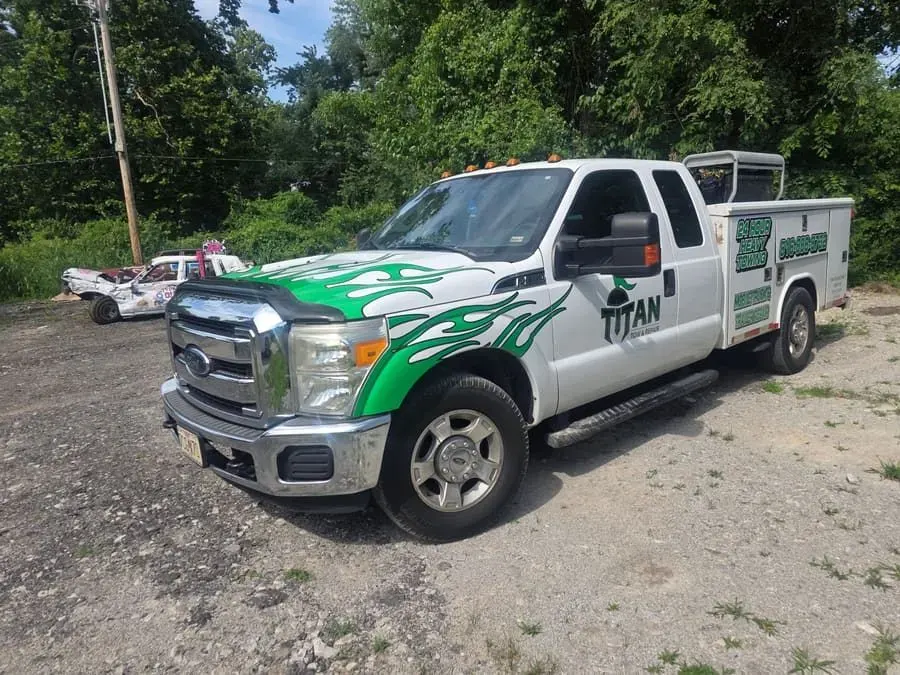
Slack adjusters, brake chambers, air lines, glad hands and the fittings around them are all on the trailer repair list, and replacing them at the roadside is routine mobile truck repair work. A seized adjuster comes off and a new one goes on and is set correctly; a chamber that will not release is replaced; a crushed line is replaced. The trailer is then aired up and the brake checked for release before it moves.
One tool worth explaining: caging a spring brake. If a chamber has failed and is holding that wheel on, the spring can be mechanically compressed — caged — with the bolt provided for it, releasing that brake so the trailer can be moved somewhere safe. That is a get-it-off-the-road step, not a repair. A caged wheel has no parking brake and reduced service brake on that corner, and 49 CFR 393.48 requires all brakes with which a vehicle is equipped to be capable of operating at all times. We will cage a chamber to get you out of a live lane, not to send you down the highway.
When the honest answer is a tow
A bearing that has run hot is a tow, and that is the boundary worth being blunt about: wheel seal and bearing replacement are not on our services list. What we do at a wheel end is tire work and the hardware around it, studs and lugs and the parts a failure takes with it. A hub that has lost its grease, a seal that has soaked the linings, a picked-up spindle or a heat-cracked drum all have to come apart on a bench. That is a shop, not a shoulder.
So the trailer is lifted at that axle and moved to the repair point rather than asked to carry itself there. The tractor need not wait with it, and the heavy-duty towing side runs out of the same Liberty yard as the service truck, so one call settles which is coming. Call while the drum is the hot part and the hub is merely warm, and you will very probably avoid all of it.
Sources
- 49 CFR 396.7, Unsafe operations forbidden
- 49 CFR 393.47, Brake actuators, slack adjusters, linings/pads and drums/rotors
- 49 CFR 393.48, Brakes to be operative
Related reading
DOT Out of Service: Faults That Freeze a Running Truck — An out-of-service order means the vehicle legally cannot move until the listed fault is repaired, even if it runs perfectly.
Reefer Down: Protecting the Load When the Unit Stops Cooling — When a reefer stops cooling, the load is the emergency, not the trailer.
Hot Shot Truck Broke Down: Who Actually Tows It? — A hot shot — a one-ton or medium-duty pickup pulling a gooseneck or flatbed — sits in a gap.
What this covers
Mobile trailer repair
Most trailer faults do not stop a trailer moving. They stop it being legal to move, which is worse — the load sits while the paperwork says it cannot go anywhere.
Mobile trailer repair detailsMobile truck repair
Our service truck carries the parts and the tools. Faster for your driver, cheaper for your office, and the load keeps moving.
Mobile truck repair detailsIn a specific city: Diesel mechanic and mobile semi truck repair in Kansas City, Missouri · Mobile truck and trailer repair in Riverside, Missouri · Mobile truck and trailer repair in Liberty, Missouri · Mobile semi truck and trailer repair in Saint Joseph, Missouri · Mobile truck repair and a diesel mechanic on call in Topeka, Kansas