
Your semi will not start. Battery, starter or something else?
Listen to what the truck does when you turn the key. Clicking with dim dash lights points at batteries or connections; a healthy crank with no fire points at fuel or air supply; total silence points at the starter circuit. Batteries are the most common and the most roadside-fixable — a service truck can test, jump or replace them where the truck sits.
One question splits every no-start in half
Before anything else, answer this: does the engine turn over? A truck that will not crank has an electrical problem — batteries, cables, grounds, the disconnect, the starter or its circuit. A truck that cranks strongly and will not fire has an electrical system that is working fine and a fuel, air or control problem instead.
Those two halves share almost no parts and almost no repairs, and a driver who can say which one he has on the phone saves everyone an hour. Everything below follows that split.
The thirty-second diagnosis from the driver seat
- Rapid clicking, dash lights dim or dropping out. The starter is asking for current the batteries cannot deliver. Batteries, terminals or cables — the classic call, and the most fixable one.
- One solid clunk, then nothing. Current is arriving but the starter is not spinning. Could be the starter or its solenoid, could still be a weak bank that collapses under load. A load test settles it.
- Cranks strong, will not fire. Electrics are fine. Now it is fuel, air in the fuel system, or a control fault, and in winter it is often gelled fuel.
- Cranks normally, then stops cranking and clicks. The bank had enough for the first attempt and not the second. Almost always batteries, occasionally a starter drawing far more current than it should.
- Nothing at all, not even dash lights. Main disconnect switch, a blown main fuse, a dead short, or a bank so flat there is nothing left. Check the disconnect before calling anyone; it is the free fix and it gets bumped more often than anybody admits.
| At the key | What it points at | What settles it |
|---|---|---|
| Rapid clicking, dim dash lights | Batteries, terminals or cables | Load test and a voltage-drop check |
| One solid clunk, then nothing | Starter, solenoid or a weak bank | A load test |
| Cranks strong, will not fire | Fuel, air in the fuel, or a control fault | Fuel filter, separator bowl and stored codes |
| Cranks once, then only clicks | Almost always batteries | Testing the whole bank as a set |
| Nothing, not even dash lights | Disconnect, main fuse, a short or a flat bank | Checking the disconnect switch first |
Battery, connection or starter
These three produce almost identical symptoms, which is why guessing is expensive. A corroded ground strap or a loose terminal produces every sign of a dead battery while the batteries themselves test perfectly, and it costs a fraction of a bank of batteries to put right. Any honest roadside call checks connections and does a voltage-drop check across the cables before condemning anything.
The starter is the least likely of the three and the easiest to blame. A starter that is genuinely failing usually draws heavily enough to drag the whole system down, so it looks like a battery problem until someone measures it. Starters also do not like being cranked continuously — long attempts overheat them, and a driver trying to force a start can turn a fuel problem into a starter problem.
One more free check before anyone spends money: the battery disconnect switch, the main fuses or fusible links, and the neutral or clutch interlock. A truck that is not in neutral, or whose interlock has failed, gives you silence and a completely healthy electrical system.
Why semi batteries die as a set
A truck runs three or four batteries in parallel and they age as a set. When one cell fails, the others spend their capacity backfilling it, so the first cold morning after a marginal summer kills the whole bank at once. This is why "it started fine yesterday" is the most common sentence in this line of work, and why testing the whole bank matters — dropping one new battery into a tired set buys weeks, not years.
The rating stamped on the case is the winter number. Cold cranking amps under SAE J537 is the current a 12-volt battery can deliver for 30 seconds at 0°F without its terminal voltage falling below 7.2 volts. That definition is the whole story of a winter no-start: cold thickens the electrolyte and cuts what the battery can deliver at exactly the moment a cold diesel is asking for the most.
Cranks strong but will not fire
If the starter is spinning the engine at a healthy speed, stop looking at batteries. Something is keeping fuel, air or the command to run away from the engine:
- Out of fuel, or air in the fuel system. Running a tank dry does not just empty it, it pulls air into the lines, and the system usually has to be primed before it will fire again.
- A plugged fuel filter. Dirt, water or wax. In cold weather the wax version is its own subject, covered in our post on gelled fuel and frozen air lines.
- Water in the fuel. The separator bowl is worth a look, and water that has frozen in a line stops fuel exactly the way wax does.
- A control or shutoff fault. Modern trucks will refuse to start on their own authority. If there are codes stored, they are worth reading before anybody takes anything apart.
- Cold, thick oil and low compression at cranking speed. An engine turning slowly enough to sound healthy but not fast enough to light off is a cold-start problem rather than a fuel problem.
Jump starting a truck: the right way and the wrong way
Done properly, with equipment sized for it, a jump start is safe and routine. A commercial jump pack or a service truck delivers the cranking current a cold diesel actually needs. A passenger car does not: its battery and charging system were never built to push a bank that size, and the attempt risks the car more than it helps the truck.
- Use gear rated for a heavy truck. Cables sized for a car heat up, drop voltage and deliver disappointment.
- Get the polarity right and check the system voltage. Most on-highway trucks run a 12-volt starting system built from batteries in parallel, but confirm rather than assume before anything is connected.
- Make the last connection away from the batteries. A charging battery vents hydrogen, and the final clamp is where the spark happens. Put it on a clean frame or engine ground, not on the battery post.
- Never jump a frozen, cracked or leaking battery. A frozen battery can rupture under charge. If the case is bulged or the electrolyte is visibly low, it needs replacing, not reviving.
- Crank in short attempts. Long continuous cranking cooks starters and flattens whatever you just borrowed.
- Treat the jump as a diagnosis deferred. A truck that needed a jump this morning will need one again tonight. The useful call is the one that tests why.
Cold weather turns a weak bank into a dead one
Winter does not usually create the fault, it reveals it. The battery delivers less current cold, the oil is thicker, and a diesel needs more cranking speed to fire — three things moving the wrong way at once. A bank that was marginal in September is a no-start in January, and it happens on the first genuinely cold morning across a whole yard rather than to one unlucky truck.
That is also why block heaters and honest pre-trip checks pay for themselves in this region. If a truck is cranking slowly rather than not at all, the bank is telling you what it intends to do next week.
What gets fixed at the roadside, and what to say when you call
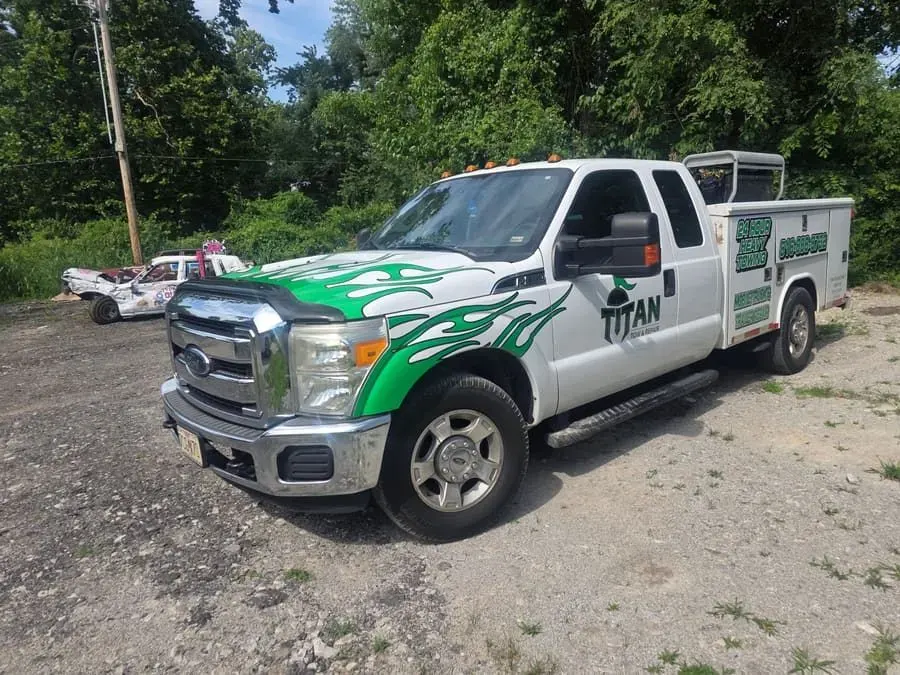
Batteries tested and replaced, terminals and cables cleaned or renewed, grounds repaired, starters and alternators swapped where access allows, fuel filters changed and systems primed — all standard work for our mobile truck repair service, and all of it saves the tow. A no-start that turns out to be a battery bank is back in service in the time a wrecker would have spent loading it. What is not roadside work is anything requiring the truck lifted, an engine that needs to come apart, or a starter buried behind components that have to come off first.
When you call, say what the truck does at the key, whether it sat overnight or died mid-day, whether anything electrical was left running, and what the dash is showing. Those four answers usually name the fault before the service truck leaves the yard. Our post on what mobile truck repair costs in Kansas City explains what drives the bill, and fleets can put the billing on an account through our fleet towing page rather than leaving a driver to authorize it.
If the truck is standing anywhere near live traffic, handle that first. Hazard flashers on, triangles out under 49 CFR 392.22, and stay out of the lane — our guide to a semi broken down on the highway covers the first ten minutes.
Sources
Related reading
Air Leak on a Semi: Roadside Fix or Tow? — Most air system faults on a semi are roadside-repairable: leaking glad hands, blown air lines, failed brake chambers, stuck slack adjusters and leaking fittings can all be replaced on the shoulder by a mobile service truck.
Semi Running Hot: Pull Over or Push On to the Next Exit? — A climbing gauge under heavy load on a grade can be normal; a gauge that keeps climbing after you shed load and speed is not.
Truck in Derate or Limp Mode: What It Means, What to Do — A derate is the engine computer cutting power because an emissions or engine reading is out of range — most often DEF quality or level, a failed regen, or a sensor.
What this covers
Mobile truck repair
Our service truck carries the parts and the tools. Faster for your driver, cheaper for your office, and the load keeps moving.
Mobile truck repair detailsFleet & commercial towing
Fleets do not need a hero, they need a truck that turns up and paperwork that reconciles. We do both.
Fleet & commercial towing detailsIn a specific city: Diesel mechanic and mobile semi truck repair in Kansas City, Missouri · Mobile truck and trailer repair in Riverside, Missouri · Mobile truck and trailer repair in Liberty, Missouri · Mobile semi truck and trailer repair in Saint Joseph, Missouri · Mobile truck repair and a diesel mechanic on call in Topeka, Kansas