
Your truck just went into derate or limp mode. Here is what it is telling you.
A derate is the engine computer cutting power because an emissions or engine reading is out of range — most often DEF quality or level, a failed regen, or a sensor. It is not the engine failing; it is the software fencing you in. Many derates are diagnosed and cleared at the roadside, but a hard 5 mph DEF derate on a countdown will not wait.
What a derate actually is
Every emissions-era truck carries software whose job is to protect the aftertreatment system, and its only enforcement tool is your power. When a reading goes out of range — DEF level, DEF quality, a soot load the regen cannot burn off, a NOx sensor that has drifted — the computer cuts torque, then speed, in programmed stages. The engine is usually fine. The computer is not asking your opinion.
That distinction matters at the roadside, because a derate is a diagnostics problem before it is a wrench problem. The fault code says which reading tripped it, and the code decides everything: whether it clears on the spot, whether it needs a part, or whether the truck is going to a shop no matter what anyone does on the shoulder.
Three different derates, and they are not the same thing
Drivers use "derate" and "limp mode" for all of it, which hides the only distinction that matters — how much truck you have left and for how long.
- Torque derate. The engine stops making full power. You feel it on grades and pulling away loaded, and the speedometer still works. The Volvo VN operator's manual documents this stage as a 25 percent torque reduction, and other makes do something comparable.
- Road speed derate. The computer caps how fast the truck will go, regardless of load or throttle. You can still make progress, and you can still choose where you stop, but you are now a slow vehicle in fast traffic and that changes which roads are sensible.
- The final inducement. The bottom rung has traditionally been a 5 mph crawl, which turns a working truck into a parked one wherever the countdown expires. Volvo announced in July 2026 that it is rolling out revised DEF software, following updated EPA guidance, that raises the final inducement speed from 5 mph to 25 mph and extends the repair window from 4 hours to 160 hours — starting with new D13 VGT and D13 TC engines in May 2026 and reaching post-2014 model years by the second quarter of 2027.
- Which one you have is not a guess. The dash tells you, and so does the truck. Know whether you have lost power, lost speed, or are watching a countdown, because the three lead to three different phone calls.
| Stage | What you notice | Keep driving? |
|---|---|---|
| Warning lamp, full power | No power lost yet | Yes, but plan a repair |
| Torque derate | Less power on grades and loaded pulls | A short run to a safe stop or shop |
| Road speed derate | Top speed capped regardless of throttle | No, a stop-now problem |
| Active countdown | Miles or hours remaining on the dash | No, use it to reach a yard or shop |
| Final inducement | Traditionally a 5 mph crawl | No, the truck stops where it expires |
Not every derate is an emissions derate
The aftertreatment system causes most of them, but engine protection causes the rest, and the two feel identical from the seat. High coolant temperature, low oil pressure and low coolant level can all pull power on their own schedule, and those are not codes to drive through while you look for a truck stop. If the temperature gauge is involved, read our post on a semi running hot before you decide anything.
This is the reason the first question on the phone is always what else is on the dash. A DEF lamp with a countdown and a coolant temperature warning are two different emergencies, and only one of them gets worse the longer the engine runs.
The usual suspects, in order
- DEF level or quality. Low DEF, contaminated DEF, or DEF topped up with something that is not DEF. EPA guidance notes that engines are certified around fluid meeting the ISO 22241-1 standard, which specifies a 32.5 percent urea concentration, and that SCR systems are calibrated to exactly that. The system tests quality, not just quantity, so a bad fill fails with a full tank.
- A regen that will not complete. Soot builds in the DPF faster than passive regen burns it off, the active regen keeps aborting, and the load crosses the line. Short urban runs are the classic cause. Our post on a DEF light and a regen that will not finish covers that case in detail.
- Sensors. NOx sensors and urea quality sensors age, foul and drift, and a sensor reading nonsense derates a perfectly healthy engine. The EPA said as much in 2026 guidance, describing significant concerns about DEF inducements caused by quality-sensor failures affecting operators unnecessarily. Infuriating, and also the single most common roadside clear.
- Wiring, connectors and heaters. DEF lines and tanks are heated, the harnesses live in road spray, and a corroded connector produces a quality or level fault with nothing wrong with the fluid at all.
- Cold. DEF freezes, and EPA guidance notes that neither NOx sensors nor quality sensors can monitor the fluid while it is frozen. A cold-weather fault is a different conversation from a summer one.
Why reading the code decides everything
Two trucks with identical dash lamps can need a top-up and a tow respectively, and nothing visible from outside separates them. A service truck with diagnostic gear reads the fault, and the fault sorts the call into three bins. Bin one is faults that clear on the spot: a forced regen where conditions allow, a DEF top-up with known-good fluid, a fouled sensor that reads sane again after attention. Bin two is faults needing a part a service body can realistically carry and fit. Bin three is shop work — a DPF that has to come off, a doser that has to come apart, anything internal.
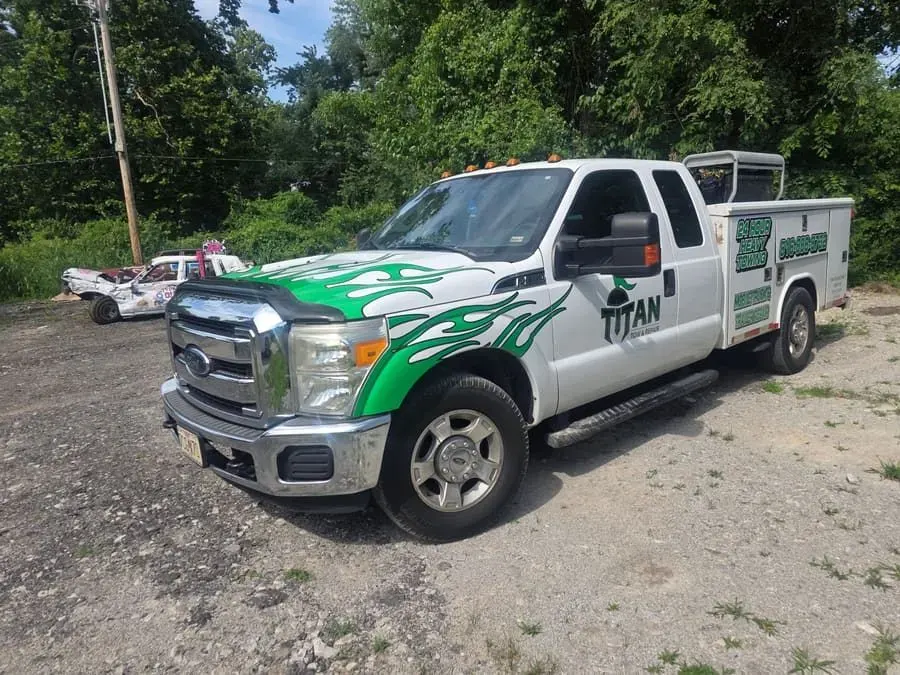
The honest version of this service is telling you which bin you are in before work starts, rather than after two hours of trying. That is what our mobile truck repair call is for, and it is why the dash message matters more than anything else you can tell us.
Five minutes of checks before the phone call
- Read the whole dash, not just the loudest lamp. Write down the exact message and code, word for word, plus any miles or hours remaining.
- Check the DEF gauge, then the tank. A gauge that reads full over an empty tank is a sensor fault, which is a different repair from an empty tank.
- Think about the last fill. Diesel, water or washer fluid in the DEF tank is a common quality fault and it happens at busy fuel islands. If there is any chance of it, say so — that turns a top-up into a drain.
- Look for the regen inhibit switch. Some trucks have one and some fleets leave it on. With it on, the truck cannot regen no matter what else is right.
- Note whether a parked regen was ever attempted. A parked regen needs the truck stationary, warm and out of gear. Driving through the warning for days without letting one run may be the whole story.
Should you keep driving it?
In a soft derate — reduced power, no countdown — finishing a short run to a safe stop or a shop is usually reasonable, and the truck will be unpleasant but functional. In a hard derate with a speed limit or an active countdown, no. A truck crawling along an interstate shoulder is a hazard to its driver and to everyone behind it, and some faults escalate if you keep loading the system.
The longer repair windows now rolling out buy time, not immunity. 49 CFR 396.7 still says a vehicle discovered to be unsafe while it is being operated may be continued only to the nearest place where repairs can safely be made, and a truck that will shortly be limited to a crawl on a highway is not a truck to nurse across a state. Use the extra hours to reach a yard or a shop, not to finish a load.
The worst move is the one that feels most productive: cycling the key repeatedly hoping it resets. Some systems log that pattern, some escalate on it, and it burns the time you could have spent getting the right truck rolling toward you.
Choosing where the truck stops
If the fix is a shop fix and the countdown is short, the useful decision is where you park, while that is still yours to decide. A truck stop, a wide exit ramp shoulder, a yard or a lot all make the next step routine. A live lane does not. Get the hazard flashers on and the triangles out under 49 CFR 392.22 the moment you stop, and if the truck is standing somewhere exposed, say so first when you call.
A tow from a safe spot is an ordinary heavy-duty towing job, and the truck goes to the shop you name rather than the nearest one to where it died. A tow from a live lane is a recovery, and it costs more in every sense. Our guide to what to do when a semi breaks down on the highway covers the first ten minutes of that.
Sources
- 49 CFR 396.7, Unsafe operations forbidden
- 49 CFR 392.22, Emergency signals; stopped commercial motor vehicles
Related reading
Semi Running Hot: Pull Over or Push On to the Next Exit? — A climbing gauge under heavy load on a grade can be normal; a gauge that keeps climbing after you shed load and speed is not.
Semi Won't Start: Jump Start, Batteries or Starter? — Listen to what the truck does when you turn the key.
DEF Light or Regen Stuck: What to Do Before the Derate — A DEF or regen warning is a countdown, not a breakdown.
What this covers
Mobile truck repair
Our service truck carries the parts and the tools. Faster for your driver, cheaper for your office, and the load keeps moving.
Mobile truck repair detailsHeavy-duty towing
A loaded tractor-trailer is not a bigger car. It needs a rated wrecker, a rated operator and a plan before anything gets hooked. That is what we send.
Heavy-duty towing detailsIn a specific city: Heavy-duty, semi and semi trailer towing in Kansas City, Missouri · Diesel mechanic and mobile semi truck repair in Kansas City, Missouri · Heavy-duty towing in Liberty, Missouri · Mobile truck and trailer repair in Riverside, Missouri · Mobile truck and trailer repair in Liberty, Missouri · Heavy-duty, semi and semi trailer towing in Kansas City, Kansas · Heavy wrecker service and semi towing in Saint Joseph, Missouri · 24/7 semi and heavy-duty towing in Oak Grove, Missouri · Heavy-duty and semi towing in Topeka, Kansas · Mobile semi truck and trailer repair in Saint Joseph, Missouri · Mobile truck repair and a diesel mechanic on call in Topeka, Kansas