
A suspension airbag let go and the truck is sitting on its stops. Can you drive it?
A loaded semi should not be driven on a blown air bag, and no truck should move with the axle down on the frame or a tire touching anything. Empty, level and at low speed, a short limp to an exit or nearby yard is sometimes possible. Air bags and the height-control valves, arms and lines around them are replaced at the roadside, on tractors and trailers.
What the air suspension is doing when it works
Air suspension holds the truck up on rubber bags inflated from the same air system that works the brakes, with a height-control valve at each corner or axle group metering air in and out to hold the ride at a set height. Load the truck and the valve adds air; unload it and the valve lets air out. The bag is the spring; the valve decides how tall that spring stands.
Ride height is not cosmetic. It sets the driveline angles between the transmission and the axles, the height of the fifth wheel relative to the kingpin, the height of the trailer floor against a dock, and how much frame sits above the tires. 49 CFR 393.207 requires that the vehicle be level, not tilting left or right, that the air pressure regulator not let air into the suspension until at least 55 psi is in the braking system, and that air leakage be no greater than 3 psi in a five-minute period at normal operating pressure.
That 55 psi rule sets the order of events on a truck with a suspension leak: brakes get air first and the suspension gets what is left, so a big enough suspension leak becomes a brake problem rather than just a ride problem.
What actually happened out there
When a bag ruptures or its bead lets go, air leaves faster than the valve can replace it. That corner drops onto its bump stops, and because the valve keeps trying to fill a bag that will not hold, it can pull the whole circuit down with it. The truck sits low and lopsided, the compressor runs constantly, and you can usually hear the leak from outside the cab.
It happens on tractors and trailers alike, for ordinary reasons: age and dry rot, a bag chafing on something it should not touch, road debris, a tire failure that threw a carcass into the bag, or a cracked bag that finally gave up under load.
Blown bag, leaking system, or a height-control valve?
Several faults look nearly identical from the driver's seat, and telling them apart on the phone decides which parts come out on the service truck.
- A blown bag. One corner, dropped fast, with a loud steady hiss at the bag. A split, a bead off the plate, or a bag folded flat under the axle is unmistakable from a few feet away.
- A leaking system. The truck sinks over an hour or overnight rather than dropping in seconds, and the compressor cycles more than it should. The leak is at a fitting, a line or the valve body, and may be nowhere near the bag that looks lowest.
- A failed height-control valve. The bag is intact but the corner will not come up, or it rises too far and stays there, or it dumps whenever you park. A valve stuck in exhaust holds the truck down; one stuck in fill can overextend the bag.
- A broken linkage. The valve reads ride height through an arm and a link rod to the axle. Break that link and the valve has no idea where the axle is, so it fills or exhausts forever while the bag is perfectly sound.
- The dump valve left open. Trailer dump valves exist to drop the deck at a dock. 49 CFR 393.207 limits how they may be fitted — controls that exhaust one axle of a two-axle air suspension trailer must be on the trailer, or arranged so the combination cannot exceed 10 miles per hour while the air is out. Check the valve is in the ride position first.
| Fault | How it shows | The tell |
|---|---|---|
| Blown air bag | One corner dropped fast | Loud steady hiss at the bag |
| Leaking system | Sinks over an hour or overnight | Compressor cycles more than it should |
| Failed height-control valve | Bag intact, corner will not hold height | Hiss at the valve, not the bag |
| Broken linkage | Valve fills or exhausts forever | Arm or link rod disconnected from the axle |
| Dump valve left open | Trailer deck dropped as at a dock | Valve not in the ride position |
Loaded or empty is the whole question
Empty and on level ground, a truck with one bag gone is sometimes drivable a short distance at low speed. The axle is on its stops, the ride is terrible and the driveline angles are wrong, but nothing is grinding and nothing is about to come apart. A slow limp to the next exit or a nearby yard can be the sensible move, and the service truck can meet you there instead of on the shoulder.
Loaded, the answer changes completely. The weight the bag was carrying now sits on the bump stops and the frame, the tires on that side can be pushed into the body or the mudflaps, and the driveline runs at angles it was never built for. 49 CFR 396.7 forbids operating a vehicle in a condition likely to cause an accident or a breakdown, and allows continuing only to the nearest place where repairs can safely be effected. If the axle is on the frame, or a tire is touching anything, the truck stays where it is.
What it does to the trailer and the fifth wheel
On a tractor, a dropped drive-axle suspension lowers the fifth wheel and tips the trailer nose-down. That changes the trailer's approach and departure angles, so a rig that cleared a railroad crossing or a steep dock approach this morning may drag its landing gear or rear frame over the same ground this afternoon. It also changes how the kingpin sits in the jaws.
On a trailer, a dropped bag tips the deck and shifts weight onto the neighboring axle and its tires. A loaded trailer sitting on its stops puts static load into the frame and the suspension hangers that they were never designed to take, and 49 CFR 393.207 requires that no axle positioning part be cracked, broken, loose or missing and that axles be in proper alignment. That is the rule a dropped corner is most likely to end up breaking.
Height is the quiet one. A tractor sitting low, or a trailer dropped at the rear, changes overall height slightly — rarely enough to matter on an interstate, exactly enough to matter at a dock or a canopy.
Checks before you call
The checks below need no tools, and none of them require getting underneath anything. Do them standing, on the safe side of the truck.
- Which axle. Steer, drive or trailer, and which side. That decides the part, and whether the tractor or the trailer needs moving.
- Is air still building. Watch the gauges. If the system holds pressure, the brakes are fine; if it cannot, you have a bigger air problem than a bag — our guide to roadside air leaks covers that case.
- Where the hiss is. A steady hiss at the bag is the bag. A hiss at the height-control valve or a line fitting is a different and often smaller repair.
- Tire contact. Look at whether the tires on the low side are touching the body, the frame or a mudflap bracket. If they are, do not move the truck.
- The dump valve and linkage. Check the trailer dump valve is in the ride position, and that the height-control arm and link rod are still connected.
- Where it is sitting. Shoulder, live lane, exit or yard. A live lane sets the priority, and the flashers and warning triangles in 49 CFR 392.22 come first either way.
What gets fixed where the truck is
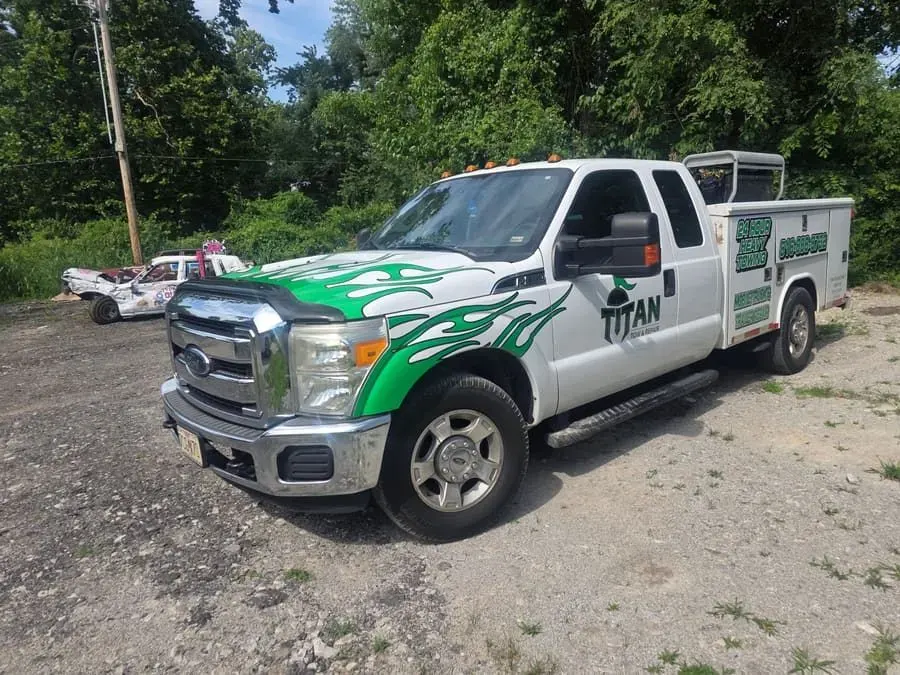
Air bag replacement is regular mobile truck repair work, on tractors and on trailers. Tell us the make, model and axle when you call so the right bag comes on the first trip. The height-control valve, its arm and link rod, and the lines and fittings around it are the same job, and are often the real culprit when a bag looks fine but the corner will not hold height. The truck is lifted, the failed part comes out, the new one goes in, the system is aired up and leak-checked, and you drive away level. On a trailer it is the same work under the trailer repair heading, and the tractor does not have to be there.
There is one honest limit. The bag is the easy part; what it was mounted to is not. If the failure has cracked a hanger, bent a bracket or damaged the upper mounting plate, that is shop work — we do not do structural welding, and a new bag on a broken mount only hides the fault until the next load. A damaged suspension is also an inspection item, which our post on DOT out-of-service faults covers.
When it is a tow
Loaded, with the axle down on the frame, is a tow: the truck goes to a shop with the suspension supported rather than carrying itself there. So is any failure that has taken a hanger, a bracket or an axle positioning part with it, and any suspension leak large enough that the truck cannot hold brake pressure. On a trailer, the tractor does not have to stay with the problem — the trailer is lifted and moved to a repair point while the tractor goes on.
The heavy-duty towing side and the service truck run from the same yard in Liberty, so one call sorts out which is coming. If the honest answer on the phone is the wrecker, you hear that before anyone rolls.
Sources
- 49 CFR 393.207, Suspension systems
- 49 CFR 396.7, Unsafe operations forbidden
- 49 CFR 392.22, Emergency signals; stopped commercial motor vehicles
Related reading
DEF Light or Regen Stuck: What to Do Before the Derate — A DEF or regen warning is a countdown, not a breakdown.
Gelled Fuel and Frozen Air Lines: Winter Truck Breakdowns — When a truck dies in a Missouri cold snap it is usually one of two things: diesel gelled in the filters, or moisture frozen in the air system.
Hot Shot Truck Broke Down: Who Actually Tows It? — A hot shot — a one-ton or medium-duty pickup pulling a gooseneck or flatbed — sits in a gap.
What this covers
Mobile truck repair
Our service truck carries the parts and the tools. Faster for your driver, cheaper for your office, and the load keeps moving.
Mobile truck repair detailsHeavy-duty towing
A loaded tractor-trailer is not a bigger car. It needs a rated wrecker, a rated operator and a plan before anything gets hooked. That is what we send.
Heavy-duty towing detailsMobile trailer repair
Most trailer faults do not stop a trailer moving. They stop it being legal to move, which is worse — the load sits while the paperwork says it cannot go anywhere.
Mobile trailer repair detailsIn a specific city: Heavy-duty, semi and semi trailer towing in Kansas City, Missouri · Diesel mechanic and mobile semi truck repair in Kansas City, Missouri · Heavy-duty towing in Liberty, Missouri · Mobile truck and trailer repair in Riverside, Missouri · Mobile truck and trailer repair in Liberty, Missouri · Heavy-duty, semi and semi trailer towing in Kansas City, Kansas · Heavy wrecker service and semi towing in Saint Joseph, Missouri · 24/7 semi and heavy-duty towing in Oak Grove, Missouri · Heavy-duty and semi towing in Topeka, Kansas · Mobile semi truck and trailer repair in Saint Joseph, Missouri · Mobile truck repair and a diesel mechanic on call in Topeka, Kansas