How a semi actually gets towed, start to finish
Towing a semi starts with a walk-around, not a hook. The operator protects the drivetrain by pulling the axle shafts or dropping the drive shaft, supplies air to release the spring brakes, lifts from rated points on the frame or axles, and only then moves the unit. The extra minutes are what save the transmission.
Why you cannot hook a semi like a car
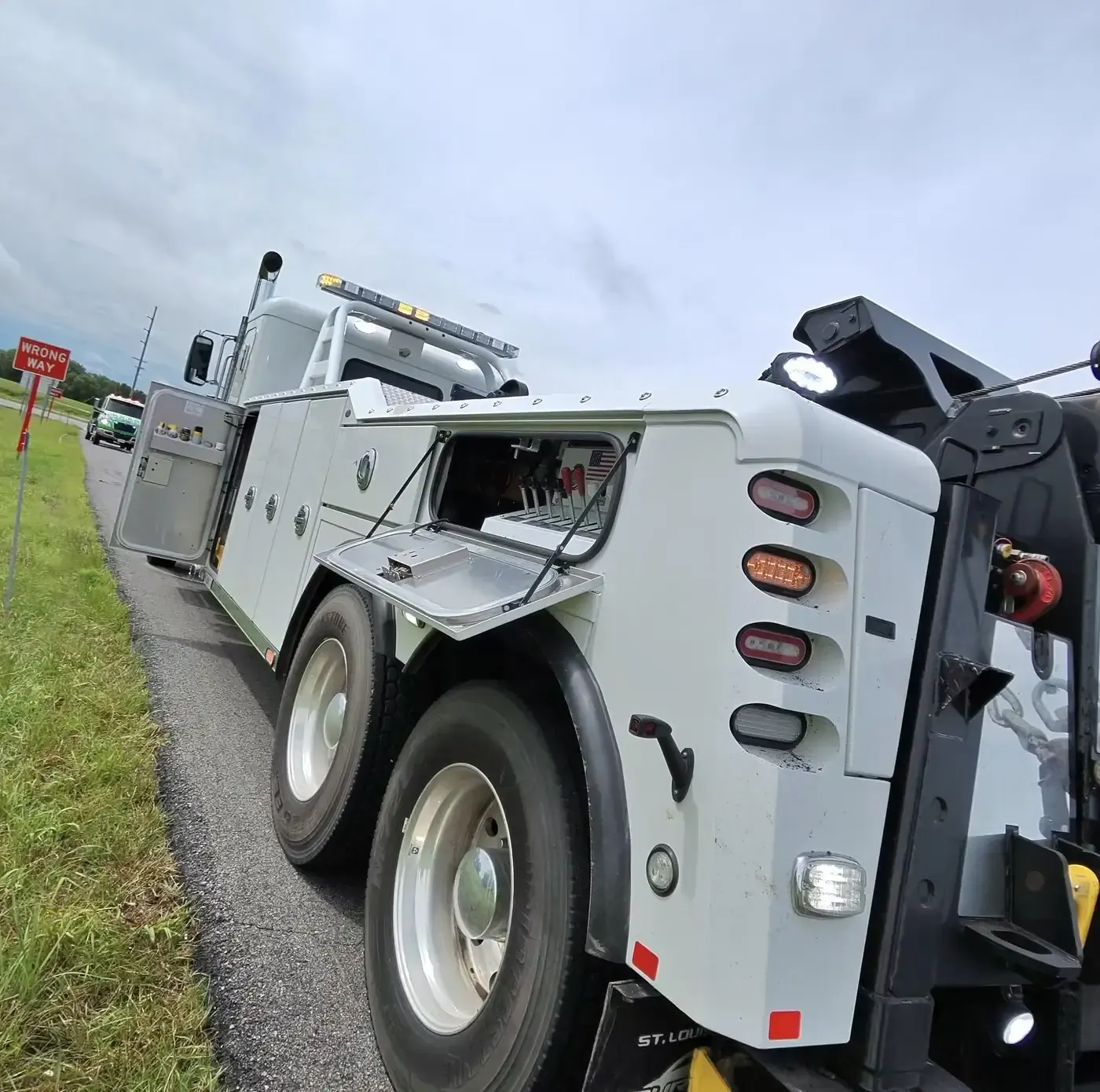
A car tow is simple because a car is simple: lift one end or put the whole thing on a deck, and drive away. A semi fights back in three ways. Federal limits on the Interstate System under 23 CFR 658.17 allow 80,000 pounds gross, 20,000 on a single axle and 34,000 on a tandem, so the weight alone puts it beyond a rollback deck. Its brakes clamp on automatically the moment the air system loses pressure — that is the design, not a fault. And its drivetrain is damaged by exactly the thing a tow does: rolling the drive wheels with the engine off.
That last one deserves spelling out, because it is the mistake that costs the most. On a heavy truck the transmission is lubricated while the engine runs. Tow the unit with the drive axles turning and the wheels back-drive the gears with no oil circulating, for every mile of the trip. An automated transmission makes it worse: there is no neutral you can trust to fully disconnect the driveline, whatever the dash says.
A proper heavy tow is not a bigger car tow. Every step below exists because skipping it breaks something specific.
First, the walk-around
Before anything is hooked, the operator walks the unit. It looks uneventful. It is the plan being built, and it decides how long everything after it takes.
- How it is sitting, and on what. Level on a paved shoulder, nose-down on a verge, or partly off the pavement. Anything off the road gets recovered before it is towed.
- Whether it is loaded, and with what. 49 CFR 393.100 requires cargo to be secured so it cannot shift enough to affect stability, or leak, spill or fall. A load that has already moved is stabilized first.
- Whether the truck still builds and holds air. This decides how the brakes get released, and it is the most consequential answer of the walk-around.
- What is bent, leaking or hanging. Fuel, coolant and oil on the ground change the sequence. A torn air line changes the brake plan. Anything dragging gets secured first.
- Where the rated lift points are. Front-end damage can mean towing from the rear, which changes the lift, the lights and the brake plan together.
- Whether the trailer is staying attached. Its condition, its brakes, its wheel ends, and whether it and the tractor are going to the same place.
- What is around the truck. Traffic, grade, guardrail, and where the wrecker can stand.
Protecting the drivetrain: shafts out or shaft down
The driveline has to be disconnected before the drive wheels roll, and there are two standard ways to do it. Either the operator pulls the axle shafts out of the drive hubs — a ring of fasteners per hub, the shafts slide out, the open hubs get capped to keep the lubricant in and the dirt out — or the drive shaft comes down at one end and is secured out of the way. Both are ordinary practice, not exotic surgery.
Which one depends on the truck, the transmission, the tow distance and the destination. Either way it takes minutes with hand tools, the parts ride along, and everything is reinstalled on arrival. Those minutes are the cheapest part of the whole job.
A third option removes the question entirely: lifting the drive axles instead of the steer axle, so the drive wheels never turn at all. That is what a rear hook does.
Air, spring brakes and caging
A heavy truck's parking and emergency brakes are spring brakes: a coil spring holds the brake on, and air pressure holds the spring back. Lose the air and the springs apply the brakes. That is the safety design, and it is why a truck with a blown air line sits there with its wheels locked.
In a normal tow the wrecker supplies air to the casualty, so the spring brakes release and the trailer brakes and lights work behind it. That is what happens whenever the system still holds pressure.
When it will not — a burst line, a failed valve, a torn chamber — the springs have to be wound back mechanically. That is caging: a bolt is threaded into the brake chamber and tightened until the spring is held off. It is the operator's job, never the driver's, and it is done with wheels chocked, because a truck with every brake caged has nothing holding it but chocks and gravity. If your truck will not release its brakes, why a semi's brakes will not release covers the causes.
The lift, and the decisions that shape it
The lift itself is quick once everything above is settled. The wrecker backs in, the underlift extends, and the load is taken on rated points — the steer axle, the frame rails, or the drive axles on a rear hook. Never a bumper, never steering components. The height is then set so the unit tows level and legal.
- Loaded or bobtail. A bobtail tractor is a straightforward lift. A loaded combination is heavier and rigged differently, and if the load has shifted nothing moves until it is stabilized.
- Trailer attached or split. A roadworthy trailer with a secure load usually tows behind the tractor as one combination. A damaged trailer, or two destinations, means two moves. A trailer can be towed without its tractor, which is how the split half gets home.
- Front hook or rear hook. Steer-end damage can force a tow from the rear, which reverses the lift points and the lighting. Still routine — just not fast.
- Steering, on a front lift. With the steer axle in the air, the front wheels are tied or locked so they cannot wander behind the wrecker.
- How it got there. A unit off the pavement is recovered first, towed second. Winch-out or recovery explains that line.
- Where it is going. Distance changes the driveline decision, and the destination has to be able to take a towed unit at the hour it arrives.
Securing, lighting and the trailer
Once the unit is up, it gets secured. Safety chains or straps go on as a second connection independent of the underlift, so nothing depends on one component. Loose items, torn panels and hanging lines get tied back, because anything that can swing will swing at highway speed. Then it is all walked again before it moves.
Lighting is next, and it is not optional. The rearmost point of what is towed has to show working stop, tail and turn lamps to the traffic behind it. When the casualty's own lighting works and the wrecker can supply it, that is what gets used. Otherwise — dead batteries, a torn harness, collision damage — magnetic or strapped tow lights go on the back.
The trailer is a decision of its own. If it is roadworthy and the load is secure, it usually stays coupled and rides on its own axles behind the tractor. If it is damaged, if its brakes or wheel ends have failed, or if it is going somewhere different, it gets dropped on its landing gear or hooked separately as a second job. Faults that do not need a tow at all are trailer repair work, done where the trailer stands.
What the driver does while it happens
Stay out of the working area. Behind the guardrail or well clear on the non-traffic side — not beside the operator, not between the wrecker and the truck, and never under anything. The lines and chains are under real load.
Do not touch the brakes. Do not release them, cage anything, or put the transmission in neutral to be helpful. The brakes come off when the operator has the unit held and not a moment before — a semi that starts rolling on a grade because someone helped is the worst version of this day.
What helps is answering the questions: what failed, what the load is, whether the truck built air before it quit, and where it needs to end up — your shop, a dealer, or our yard at 2751 Liberty Landing Rd. in Liberty. If the fault sounds fixable where it stands, say so early, because mobile truck repair beats a tow on cost and time whenever it is honestly an option.
After the tow: what to check and what to file
- Watch the driveline go back in. Axle shafts or drive shaft reinstalled, caps replaced, fasteners torqued. Pulling axle shafts opens the hubs, so check the hub oil levels too.
- Look at the lift points. Frame, steer axle or drive axles, and anything the underlift touched. Note anything marked before it becomes a question later.
- Air up and test the brakes. Build pressure, release, apply, listen. Anything caged must be confirmed uncaged and working.
- Keep the paperwork. Vehicle, driver, location, time, destination and what was done — what a carrier's safety department and an insurer need. Reconstructing it later never goes well.
- Do not drive on the fault. A unit towed for a brake, steering or wheel-end problem is not roadworthy just because it arrived. Get it signed off first.
Sources
- 23 CFR 658.17, Weight
- 49 CFR 393.100, Applicability and general requirements of cargo securement standards
Related reading
Hot Shot Truck Broke Down: Who Actually Tows It? — A hot shot — a one-ton or medium-duty pickup pulling a gooseneck or flatbed — sits in a gap.
Can a Trailer Be Towed Without Its Tractor? — Yes.
Where to Place Warning Triangles When a Semi Breaks Down — Turn on your hazard flashers immediately, then place three warning triangles as soon as possible and within 10 minutes.
What this covers
Heavy-duty towing
A loaded tractor-trailer is not a bigger car. It needs a rated wrecker, a rated operator and a plan before anything gets hooked. That is what we send.
Heavy-duty towing detailsMobile truck repair
Our service truck carries the parts and the tools. Faster for your driver, cheaper for your office, and the load keeps moving.
Mobile truck repair detailsIn a specific city: Heavy-duty, semi and semi trailer towing in Kansas City, Missouri · Diesel mechanic and mobile semi truck repair in Kansas City, Missouri · Heavy-duty towing in Liberty, Missouri · Mobile truck and trailer repair in Riverside, Missouri · Mobile truck and trailer repair in Liberty, Missouri · Heavy-duty, semi and semi trailer towing in Kansas City, Kansas · Heavy wrecker service and semi towing in Saint Joseph, Missouri · 24/7 semi and heavy-duty towing in Oak Grove, Missouri · Heavy-duty and semi towing in Topeka, Kansas · Mobile semi truck and trailer repair in Saint Joseph, Missouri · Mobile truck repair and a diesel mechanic on call in Topeka, Kansas