What a winch-out or semi truck recovery actually costs, and why it is quoted per job
Winch-outs and recoveries are priced per job because the work varies more than any other call in towing. What you pay for is assessment and rigging time, the class of equipment that has to come, the number of operators, the ground conditions and any traffic control the responding agency requires. An honest operator states what the quote assumes before anything is hooked.
Recovery is the work before the tow
A tow moves a unit already sitting on its wheels on the pavement. Recovery is everything that has to happen first — winching, rigging, uprighting, separating — to get it there. The difference between the two, and why it matters for what you are quoted, is covered in our post on a winch-out versus a recovery.
That order matters for the bill. Once the unit is back on the pavement, the tow that follows is ordinary and priced the way any tow is — the factors are in our guide to what a heavy-duty tow costs. The recovery portion is the variable part, and it is what this article is about.
What you are actually paying for
People picture a recovery as a cable going tight, so the invoice feels wrong when the pull took minutes and the job took hours. The pull is the end of the process, not the process. What is being bought is the following, roughly in the order it happens on scene.
- Assessment. Walking the scene, working out where the weight sits, what the unit is resting on, where the ground will hold a truck and what the load will do when it moves. This decides whether the job goes well.
- Rigging. Anchors, chains, straps, shackles and snatch blocks arranged so the unit comes out the way it went in rather than sideways. That takes time and rated equipment, and it is most of the difference between a winch-out bill and a recovery one.
- The equipment. Which class of truck had to come, how many, and what gear came with them — matting, cribbing, air bags, dollies, a second line.
- Operators. The people running the rigging, plus anyone spotting or keeping the scene safe.
- Time on scene. From arrival to the moment the unit is clear, including the parts where nothing moves because an agency has not released the scene.
- Making the road right. Debris off the pavement and absorbent on fluids before lanes reopen.
Why the pull is the short part
A recovery is a calculation before it is a pull. The anchor point, the angle and the sequence decide whether the unit comes out intact or arrives on the pavement worse than it left. Get that wrong and you fold a trailer, shift a load, bend a frame or part a line under tension with people standing nearby.
So the crew spends its time on the decisions: where the wrecker can stand on ground that will hold it, which points are rated to be pulled from, whether the pull is straight or has to be redirected around an obstacle, whether the load needs securing first, and in what order it all happens. The winch then runs for as long as it takes, which on a well-planned job is not long.
That is why the cheapest recovery is the one described accurately on the phone. The expensive version is where the wrong truck arrives, looks at the scene and calls for the right one. A clear description and one photo of how the unit is sitting, taken from somewhere safe, is worth more to your invoice than anything else you can do.
How the unit is sitting, and what it is sitting in
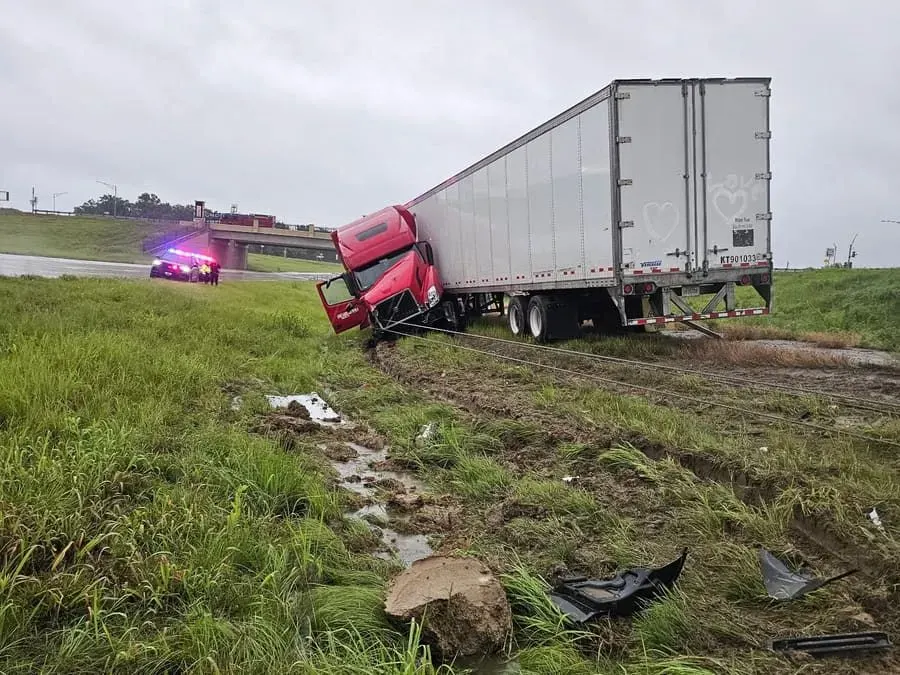
You cannot change how the truck came to rest, but you can make sure the person quoting knows exactly how it sits. Upright, empty, close to the pavement and on ground firm enough to set a truck on is the straightforward version. Every item below moves the job away from that.
- Depth and grade. A unit that slid onto a level shoulder is a different job from one below grade in a ditch or down an embankment, where the pull comes up as well as out.
- What the ground is. Firm gravel, soft shoulder, saturated mud, snow and ice each change where the wrecker can sit and how much of the pull fights the ground. A truck sunk to the axles has to be freed before it moves.
- Loaded or empty. A loaded trailer is heavier and may need stabilizing first. A shifted load can turn a short pull into a long afternoon — our post on what happens to your load covers how that gets decided.
- Resting against something. A guardrail, tree, fence line or other vehicle means the unit cannot simply be pulled backward; it has to be eased clear first.
- Room to work. A narrow shoulder, a barrier wall, a bridge deck or a tight yard leaves nowhere to position the pulling truck, forcing longer lines and redirected angles. A field gate or service road can be the difference between a short pull and a long one from the pavement.
| Costs less when | Costs more when | |
|---|---|---|
| Depth and grade | Slid onto a level shoulder | Below grade in a ditch or embankment |
| What the ground is | Firm enough to set a truck on | Soft, muddy, icy, or sunk to the axles |
| Loaded or empty | The unit is empty | Loaded, or the load has shifted |
| Resting against something | Clear to be pulled straight back | Against a guardrail, tree, fence or vehicle |
| Room to work | A field gate or service road gives access | Narrow shoulder, barrier wall, bridge deck or tight yard |
| Trucks needed | One truck and a straight pull | A second unit to hold or stabilize |
Operators, and who else the scene needs
One truck pulls; sometimes another has to hold, stabilize or catch the unit as it comes over. The moment a job needs two trucks you are paying for two crews, and the cost structure changes. That is legitimate when genuinely needed and an obvious padding opportunity when it is not, which is why you ask before the job starts why each unit is coming.
The scene itself can also require people who are not pulling anything. On a highway recovery the responding agency — law enforcement, fire or the state DOT — decides whether lanes close, in what order things get moved, and when the scene is released. Where they require traffic control, someone has to provide it, and that is time and sometimes equipment on the bill. Casualties and traffic flow come before the vehicle, and a recovery sometimes waits for an investigation to finish before anyone may touch the truck. None of that is the tow operator's decision or negotiable on scene, but knowing it in advance is what makes the hours on an invoice make sense afterward.
What makes a job escalate
Recovery quotes move because scenes turn out different from how they were described, or because the unit does something on the way out. An honest operator raises each of these with you before the extra work happens, not after.
- The unit sank rather than slid. What looked like a straight pull becomes a rigging job, sometimes with matting or cribbing under the wrecker.
- The load comes first. Stabilizing, re-securing or transferring freight is work in its own right before the recovery proper starts.
- A second unit becomes necessary. To hold the unit while the first pulls, or because tractor and trailer have to be recovered separately.
- More damage than it looked. A collapsed suspension, a locked wheel end or a bent frame changes how the unit can be pulled and how it travels afterward.
- Fluids on the ground. A ruptured tank or broken line means containment and absorbent before lanes reopen, and anything large or hazardous becomes specialist environmental work beyond what a tow company does.
- The weather turns. Rain on a clay bank, or a freeze partway through, undoes the setup.
What the invoice should itemize
A recovery invoice that is one total and a date is not something you can reconcile, dispute or file with a claim. Ask for itemization before the work starts, and check the finished invoice against what you were told on the phone. Ours carry the lines below because fleet offices and claims departments ask for them.
- The unit and the scene. Unit number, tractor and trailer identification, driver, location with highway and mile marker, and destination.
- The clock, unambiguously. Times dispatched, on scene and cleared, and which of those the billed time runs from.
- Each truck, named. Every unit that attended, with what it did. A second truck listed with no explanation is the first thing to question.
- Recovery separated from the tow. Winching, rigging and uprighting itemized apart from the tow that followed, because they are different work.
- Rigging, on the agreed basis. Some operators include rigging in the rate, some itemize straps, shackles and chains. Either is defensible; discovering which applies on the invoice is not.
- Extras, named. Cleanup, absorbent, disposal, access fees and storage, each on its own line, not folded into a round number.
What a fair conditional quote sounds like
A fair recovery quote names its assumptions. Something like: this is one truck and a straight pull, based on what you described and the photo you sent; if the trailer turns out to have sunk rather than slid, it becomes a rigging job and the price changes — and you hear that on scene before we start, not on the invoice afterward.
There are two warning signs. A firm number given instantly, with no questions asked, is a quote for the simplest possible version of the job, and the revision comes later. A flat refusal to discuss price until the truck arrives leaves you negotiating on a shoulder with no leverage. An honest operator can always tell you what the number depends on, even before they can tell you the number.
Document the scene too, if it is safe to. Photographs before and after the pull settle a dispute about what work was done far better than memory, and they are what a claims department asks for first. How we plan and price this work is on the winch-out and recovery page, and the tow that follows under heavy-duty towing.
Related reading
Semi Stuck in Mud, Snow or Soft Ground? Stop Digging — Stop spinning the wheels.
After a Semi Rollover: What Happens, Step by Step — After a rollover, people and the scene come first: emergency services, traffic control, and any leaking fuel or hazardous cargo.
Jackknifed Semi: Why It Happens and How It Is Recovered — A jackknife happens when the tractor and trailer fold at the fifth wheel, usually because wheels lock or lose traction under braking, often on a slick road, in a curve or with a light trailer.
What this covers
Winch-outs & recovery
Bad rigging wrecks loads and hurts people. Recovery is the part of this job where training is the whole difference.
Winch-outs & recovery detailsHeavy-duty towing
A loaded tractor-trailer is not a bigger car. It needs a rated wrecker, a rated operator and a plan before anything gets hooked. That is what we send.
Heavy-duty towing detailsIn a specific city: Heavy-duty, semi and semi trailer towing in Kansas City, Missouri · Heavy-duty towing in Liberty, Missouri · Winch-outs and truck recovery in Kansas City, Missouri · Heavy-duty, semi and semi trailer towing in Kansas City, Kansas · Heavy wrecker service and semi towing in Saint Joseph, Missouri · 24/7 semi and heavy-duty towing in Oak Grove, Missouri · Heavy-duty and semi towing in Topeka, Kansas · Winch-outs and emergency accident recovery in Saint Joseph, Missouri