
Your semi just broke down on the highway. Do these six things.
If a semi stops on a highway shoulder, get the unit as far right as the pavement allows, put the four-way flashers on, set reflective triangles at roughly 10, 100 and 200 feet behind it, and get yourself behind the guardrail before you make any phone call. Fix your exact position — highway, direction and mile marker — before you dial.
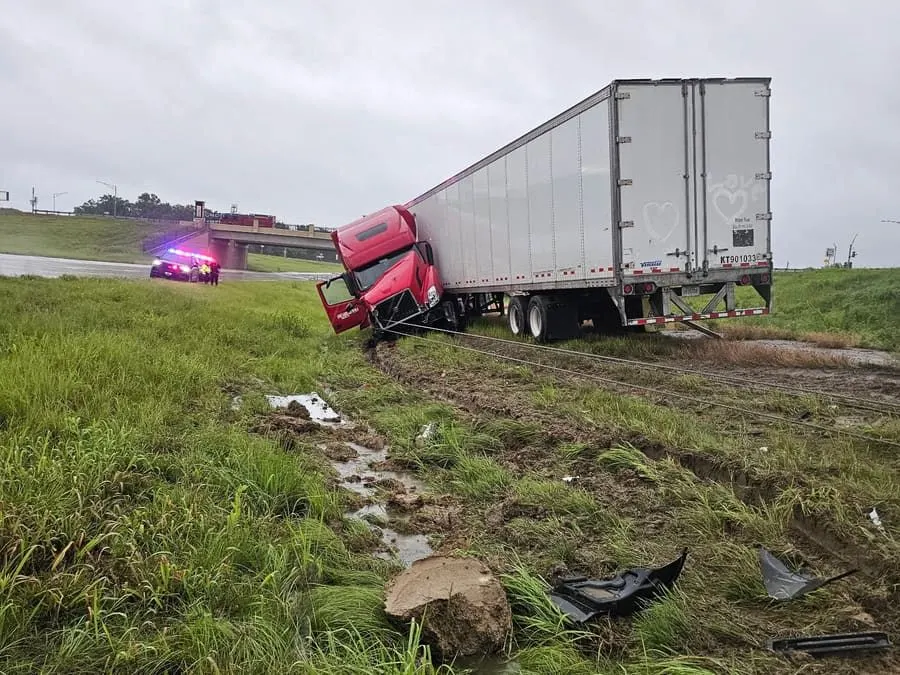
The order matters more than the speed
Almost everyone calls for help first and does the safety steps afterwards. That is backwards. The five minutes between the breakdown and the tow truck arriving are the most dangerous part of the whole event, and the phone call does not change that — the triangles do.
Federal rules require warning devices within ten minutes of stopping. That is a floor, not a target.
1. Get off the live lane if it still rolls
If the unit will still move under its own power, use it. Get onto the shoulder and as far right as the pavement allows, past the rumble strip. An exit ramp or a wide shoulder is worth limping to. A truck stopped in a live lane on I-70 through Independence is the single highest-risk situation in this whole article.
2. Hazards on immediately
Four-way flashers go on before anything else, including before you get out of the cab. They are the only warning traffic has in the first thirty seconds.
3. Triangles at 10, 100 and 200 feet
Three reflective triangles behind the unit, roughly ten feet, a hundred feet and two hundred feet back. On a curve or over a crest, put the furthest one back beyond the point where a driver can first see you — the standard distances assume a straight, flat road, and a lot of I-35 north of Liberty is neither.
If you are on a divided highway near an intersection or crossover, put one on the approach side too.
4. Get behind the barrier
Do not stand between your truck and traffic. Do not do paperwork in the cab on a narrow shoulder. Get behind the guardrail or well up the bank and make your calls from there. Struck-by incidents on the shoulder are what kill drivers and tow operators, not the breakdown.
5. Fix your position before you dial
This is the single thing that most changes how fast help reaches you. Note the highway number, the direction you were travelling, and the nearest mile marker or the last exit you passed. On a surface street, use a cross street or a business name.
"I-29 northbound, just past mile marker 14" gets a truck moving immediately. "Somewhere north of the airport" costs you twenty minutes.
6. Describe the truck honestly
When you call, say what you drive, whether it is loaded and with what, whether it still builds air and rolls, and what failed. That is what decides which truck gets dispatched. Understating the problem to get a cheaper truck sent just means waiting twice.
Then ask the question most drivers do not: can this be repaired here? Air leaks, brake chambers, batteries, starters and trailer lights often can be, and that turns a tow into a roadside fix.
What this covers
Mobile truck repair
Our service truck carries the parts and the tools. Faster for your driver, cheaper for your office, and the load keeps moving.
Mobile truck repair detailsHeavy-duty towing
A loaded tractor-trailer is not a bigger car. It needs a rated wrecker, a rated operator and a plan before anything gets hooked. That is what we send.
Heavy-duty towing details