How to choose a heavy-duty towing company before you need one
Choose a heavy-duty towing company on five things: whether their operators hold recovery certification such as WreckMaster, whether they carry on-hook and garage-keepers insurance, whether they own the equipment rather than subcontracting it, whether a person answers the phone at 3am, and whether their invoices carry the detail your office needs to reconcile.
Pick before the breakdown, not during
The worst time to evaluate a towing company is while one of your trucks is sitting on the shoulder of I-435 with a load on. You take whoever answers. Doing the work in advance — one afternoon of phone calls — is what stops that.
1. Certification, specifically for recovery
Towing and recovery are different skills. Ask whether their operators are WreckMaster certified, and at what level. An operator who can hook a tow is not automatically an operator who can upright a loaded trailer without folding it.
If the answer is vague, that is the answer.
2. Insurance, and the right kinds
General liability is table stakes. What you actually want to hear is on-hook coverage (your vehicle while it is being towed) and garage-keepers coverage (your vehicle while it sits in their yard). Ask for a certificate. A company that carries them will send one without fuss.
3. Do they own the trucks?
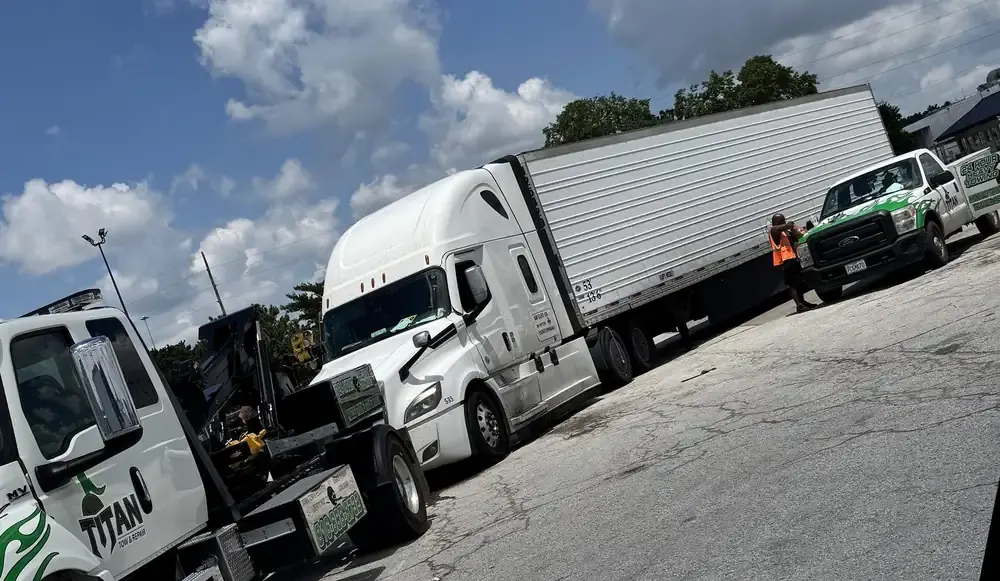
A lot of "24/7 heavy duty towing" listings are dispatch brokers. They take your call, then phone someone who owns a wrecker. You pay a margin for that and you lose control of the ETA, because the company you spoke to cannot actually tell you where the truck is.
Ask what they run, out of which yard. If they operate both heavy wreckers and a mobile service truck, that is a good sign — it means they can afford to tell you when you do not need a tow.
4. Who answers at 3am?
Call the number at an antisocial hour before you need it. You will learn more in that thirty seconds than from the entire website. A person who can tell you what they run and where they are based is a different proposition from a call centre taking a message.
5. Paperwork your office can actually file
For a fleet this matters more than it sounds. An invoice needs the unit number, the driver, the location, the time and the destination on it, or it bounces around your accounts department for a fortnight. Ask to see a sample invoice.
Ask about account setup too. Setting the account up once means a future dispatch is a single phone call with a unit number, instead of taking payment details from a driver on a shoulder in the rain.
The question that tells you most
Ask: "Do you ever tell customers they do not need a tow?"
A company that runs a mobile service truck and prices roadside repair will say yes and give you examples. A company that only owns tow trucks has no commercial reason to ever say it. That single answer tells you whose interest is being served when your truck breaks down.
What this covers
Fleet & commercial towing
Fleets do not need a hero, they need a truck that turns up and paperwork that reconciles. We do both.
Fleet & commercial towing detailsHeavy-duty towing
A loaded tractor-trailer is not a bigger car. It needs a rated wrecker, a rated operator and a plan before anything gets hooked. That is what we send.
Heavy-duty towing details