What does a heavy-duty tow actually cost in Kansas City?
Heavy-duty towing in Kansas City is quoted per job rather than from a flat price list, because the cost is driven by which truck has to roll, how far it runs, whether the unit is loaded, and whether recovery work is needed on top of the tow. Any honest operator will give you a number on the phone once you describe the vehicle and the location.
Why nobody publishes a heavy-duty price list
Light-duty towing can be advertised as a hook fee plus a per-mile rate because the job barely varies — a car is a car. Heavy duty does not work that way. The same call, described two different ways, can be an hour with one truck or five hours with three trucks and a supervisor.
Any company advertising a fixed price for heavy-duty recovery is either quoting the simplest possible version of the job, or is going to revise the number once they see the scene. Neither helps you.
The five things that actually move the price
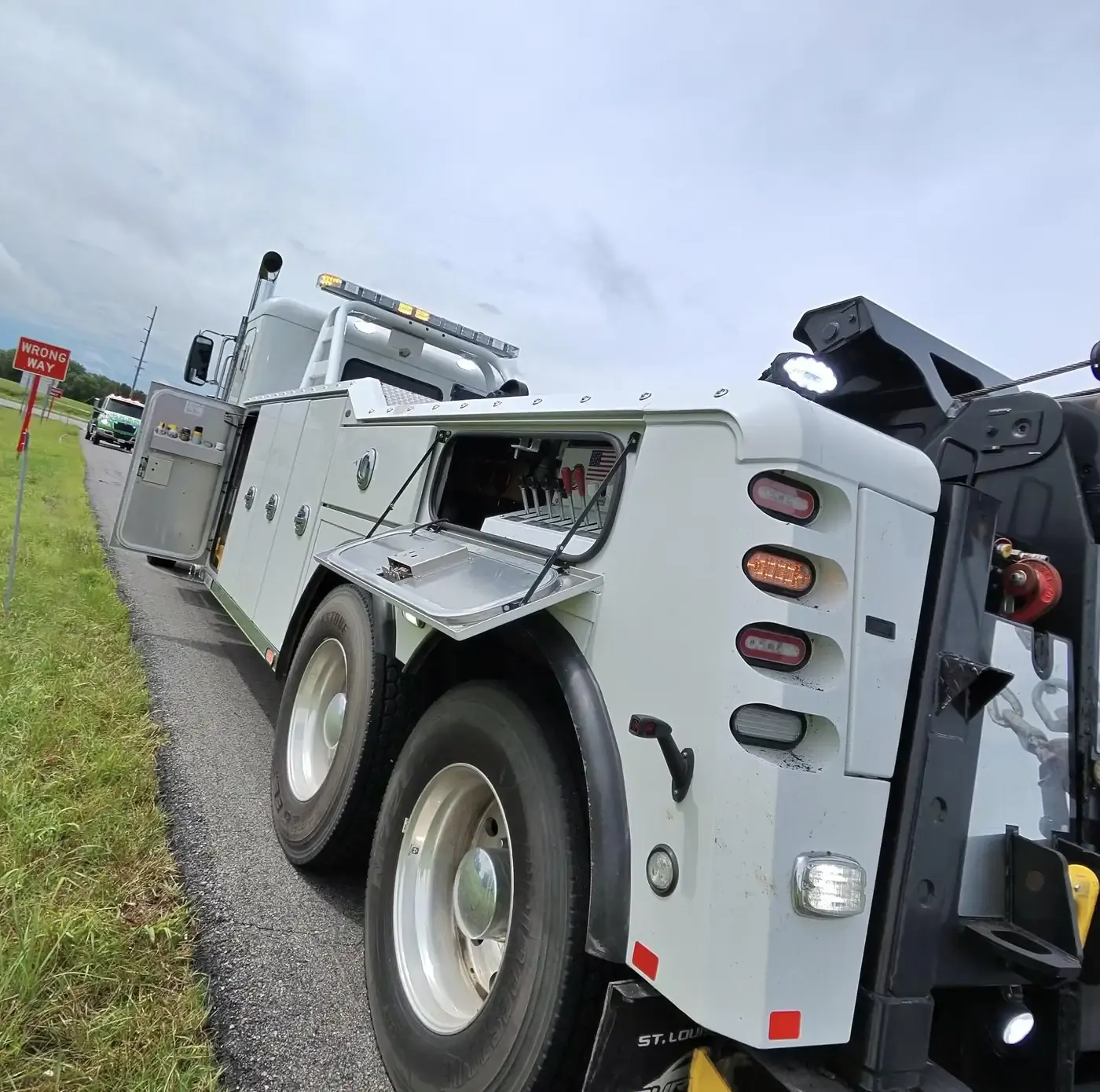
- Which unit has to roll. A rollback flatbed costs less to put on the road than a heavy wrecker. Sending the wrong one twice costs more than sending the right one once, which is why we ask what you drive before we quote.
- Loaded or empty. A loaded trailer is heavier, harder to rig and slower to move. If the load has shifted, it may need stabilising or transferring before anything is towed.
- Distance, both ways. Our yard is in Liberty. A job on I-35 near Kearney is a shorter run than one on I-70 past Blue Springs, and that difference is real money.
- Recovery on top of the tow. Winching a unit out of a ditch, uprighting a rolled trailer or separating a jackknife is separate work from the tow that follows. It needs rigging, planning and often a second truck.
- Scene conditions. Live traffic, rain, soft ground, a lane closure or a police-directed clearance all add time. Night and holiday work is not automatically more expensive with us, but it is with many operators — ask.
What a fair quote sounds like
A good quote is specific and conditional: "That is a heavy wrecker, roughly 40 minutes out, and based on what you have described it is $X. If the trailer has to be unloaded before we can move it, that changes and I will tell you before we start."
A bad quote is a single number with no conditions attached, or a refusal to give any indication at all until the truck is on scene. The second one is how people end up with an invoice they did not expect.
Five questions to ask on the phone
- Which truck are you sending, and why that one?
- What is the ETA, and is that from now or from when the driver leaves?
- What is the price based on what I have told you, and what would change it?
- Is there a storage charge if it goes to your yard, and when does it start?
- Can it be repaired here instead of towed?
The cheapest heavy-duty tow is the one you do not need
This is the part most towing companies will not tell you: a large share of the calls we get do not need a tow truck at all. Air leaks, brake chambers, batteries, starters, hoses and trailer lights are frequently fixable at the roadside, and a roadside fix means no tow bill, no shop intake and a driver who is moving again the same day.
Ask before you agree to a tow. If we can fix it where it sits, we will say so — even though the tow would have been worth more to us.
What this covers
Heavy-duty towing
A loaded tractor-trailer is not a bigger car. It needs a rated wrecker, a rated operator and a plan before anything gets hooked. That is what we send.
Heavy-duty towing detailsWinch-outs & recovery
Bad rigging wrecks loads and hurts people. Recovery is the part of this job where training is the whole difference.
Winch-outs & recovery details